
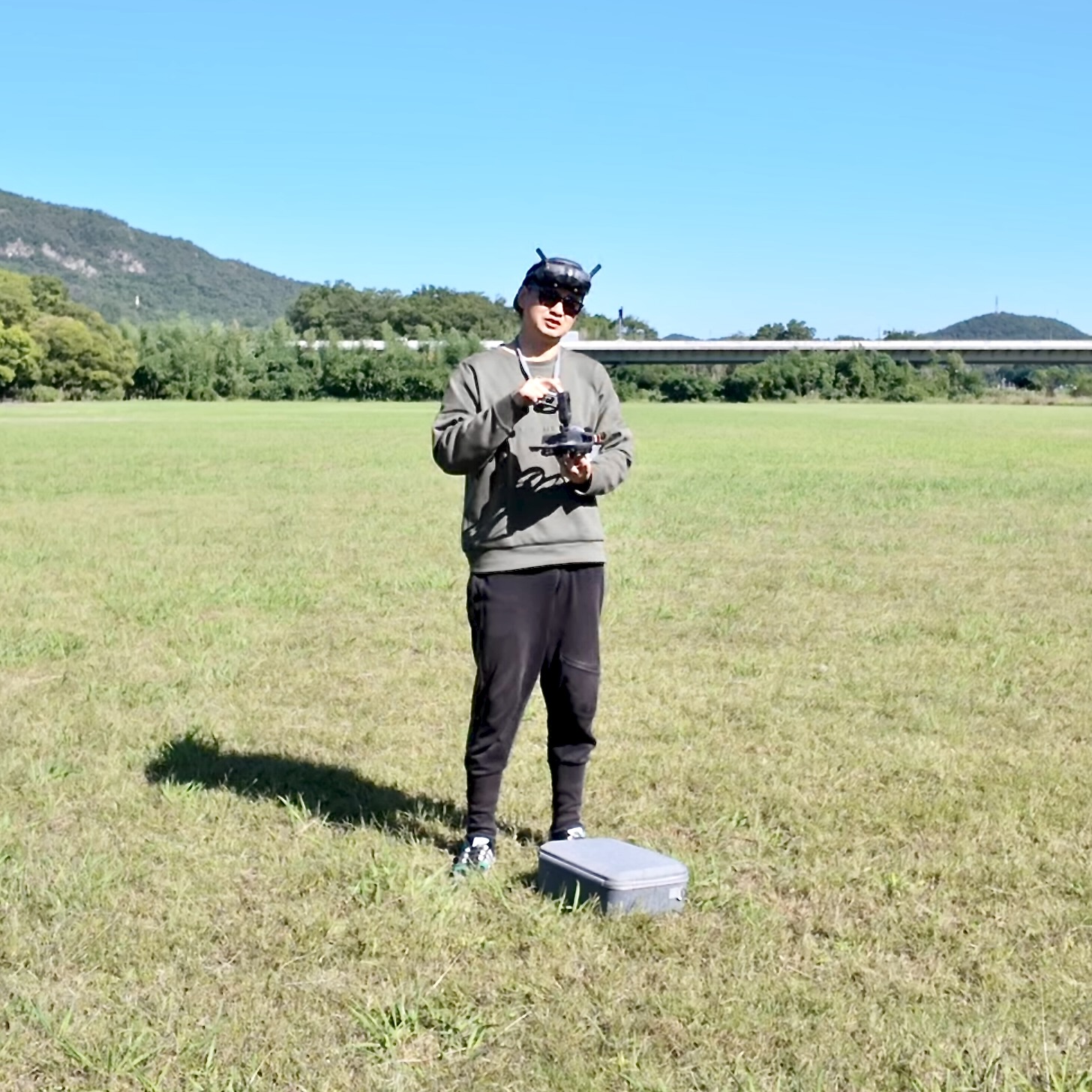
When I started learning FPV, I thought learning meant becoming better at controlling the drone.
And it did.
At first, simply keeping the drone under control required most of my attention. I had to think about throttle, pitch, roll, yaw, altitude and whatever I was trying not to crash into.
Knowing what the controls did wasn’t the same as knowing how to fly.
That required practice.
But as I became more comfortable flying, something else started to change.
I began seeing places differently.
The gap was already there
A group of trees that once looked like a group of trees could suddenly contain a route.
I would notice a gap between two trunks.
A branch might create something to fly underneath.
A building could become something to orbit.
A path could suggest a line to follow.
None of these things had physically changed.
The gap had always been between those trees.
What changed was that I had learned enough to notice it.
At first, I thought this was simply part of becoming a better FPV pilot.
Then I realized I had experienced something similar elsewhere.
I learned to see my garden differently too
When I first started gardening, much of what I saw was simply plants.
I could read about pruning, soil, fruit trees and different gardening methods, but knowing about those things didn’t mean I knew what to do when standing in front of a particular plant.
So I experimented.
Sometimes things worked.
Sometimes they didn’t.
I watched what happened afterward.
Gradually, I began noticing things I hadn’t noticed before.
New growth.
Old wood.
The direction a branch was growing.
How a plant responded after being cut.
Where something was becoming too dense.
When leaving something alone might be better than interfering with it.
The plants had been giving me information all along.
I simply hadn’t learned how to see much of it yet.
Learning can change perception
I became curious whether this was merely my experience.
It isn’t.
Researchers studying perceptual learning have found that experience can change our ability to extract useful information from what we perceive.
Experts and beginners can look at the same situation without necessarily noticing the same things.
An experienced person has learned which patterns and relationships matter.
This also helps explain something else I experienced while learning FPV.
In the beginning, so much attention was required simply to control the drone that there wasn’t much attention left for anything else.
With practice, some of those movements became increasingly automatic.
I didn’t have to consciously think about every small stick movement anymore.
That left more attention available for looking ahead.
And once I could look ahead, I could begin seeing possibilities rather than merely obstacles.
Experience teaches us what matters
The same thing happens in many fields.
An experienced mechanic can look at an engine and notice something I wouldn’t.
A gardener can look at a plant and see signs that mean very little to someone without gardening experience.
A photographer may notice light that someone else simply experiences as a bright afternoon.
An experienced FPV pilot may see a line through a place where a beginner sees trees, buildings and obstacles.
Paying attention matters.
But attention alone isn’t always enough.
Two people can look carefully at exactly the same thing and still notice different information.
Sometimes we first have to learn what to notice.
Perhaps this is part of what we call intuition
I’ve noticed this increasingly in my gardening.
There are things I once would have researched before doing that I now sometimes do almost instinctively.
That doesn’t mean I’ve somehow stopped using knowledge.
Perhaps some of that knowledge has simply become less conscious.
Past experiments, mistakes and observations have accumulated.
Instead of remembering a rule and deliberately applying it every time, I sometimes recognize something without being able to immediately explain everything that led me there.
Of course, intuition can still be wrong.
Experience doesn’t make anyone infallible.
And expertise in one area doesn’t automatically transfer to another.
Learning FPV doesn’t make me better at understanding plants. Gardening doesn’t make me a better pilot.
Each activity gradually teaches me to notice different things.
Learning isn’t only adding knowledge
I used to think about learning mainly as accumulation.
I learn something I didn’t know.
I practice something I couldn’t do.
Eventually, I know more or become more capable.
I still think that’s true.
But now I think learning can change something else too.
It can change what becomes visible.
When I learn about gardening, the garden contains more information.
When I learn filmmaking, an ordinary scene can contain a shot I wouldn’t previously have noticed.
When I learn FPV, a familiar place can contain a flight line I couldn’t see before.
The place hasn’t changed.
The garden hasn’t changed simply because I learned something.
The gap between the trees didn’t suddenly appear.
I learned to notice what was already there.
Sources
Philip J. Kellman & Patrick Garrigan — Perceptual Learning and Human Expertise
A review of perceptual learning and how experience improves our ability to extract relevant patterns and structure from information.
PubMed — Perceptual Learning and Human Expertise
S. Brams et al. — The Relationship Between Gaze Behavior, Expertise, and Performance: A Systematic Review
A systematic review examining differences in visual attention and gaze behavior associated with expertise.
PubMed — The Relationship Between Gaze Behavior, Expertise, and Performance


Leave a Reply