
For years, I wanted to become financially free.
At first, that was simply the language I used for what I wanted. I wanted enough financial security that money and employment would no longer determine so many of my choices.
Later, I learned about FIRE: Financial Independence, Retire Early.
I understood the idea, but retiring early was never really my goal. I didn’t want to stop working or doing things. I wanted to reach a point where working for someone else was no longer financially necessary.
Eventually, I began calling that financial independence.
But looking back, there is something strange about it.
I don’t actually know when I became financially independent.
There was no finish line
Financial independence is often expressed as a number.
Reach a certain net worth. Accumulate enough investments. Generate enough income from assets to cover your expenses.
Those calculations can be useful.
But my own experience didn’t happen so neatly.
I had been investing and gradually building additional sources of income for years. We also owned our home in the Netherlands and had begun renting out part of it while still living there ourselves.
Then I lost my job.
After many years with the company, I received a transition payment.
I could have kept that money as a financial buffer while deciding what to do next.
Instead, I used a substantial part of it to try something I had been thinking about.
Changing what we already had
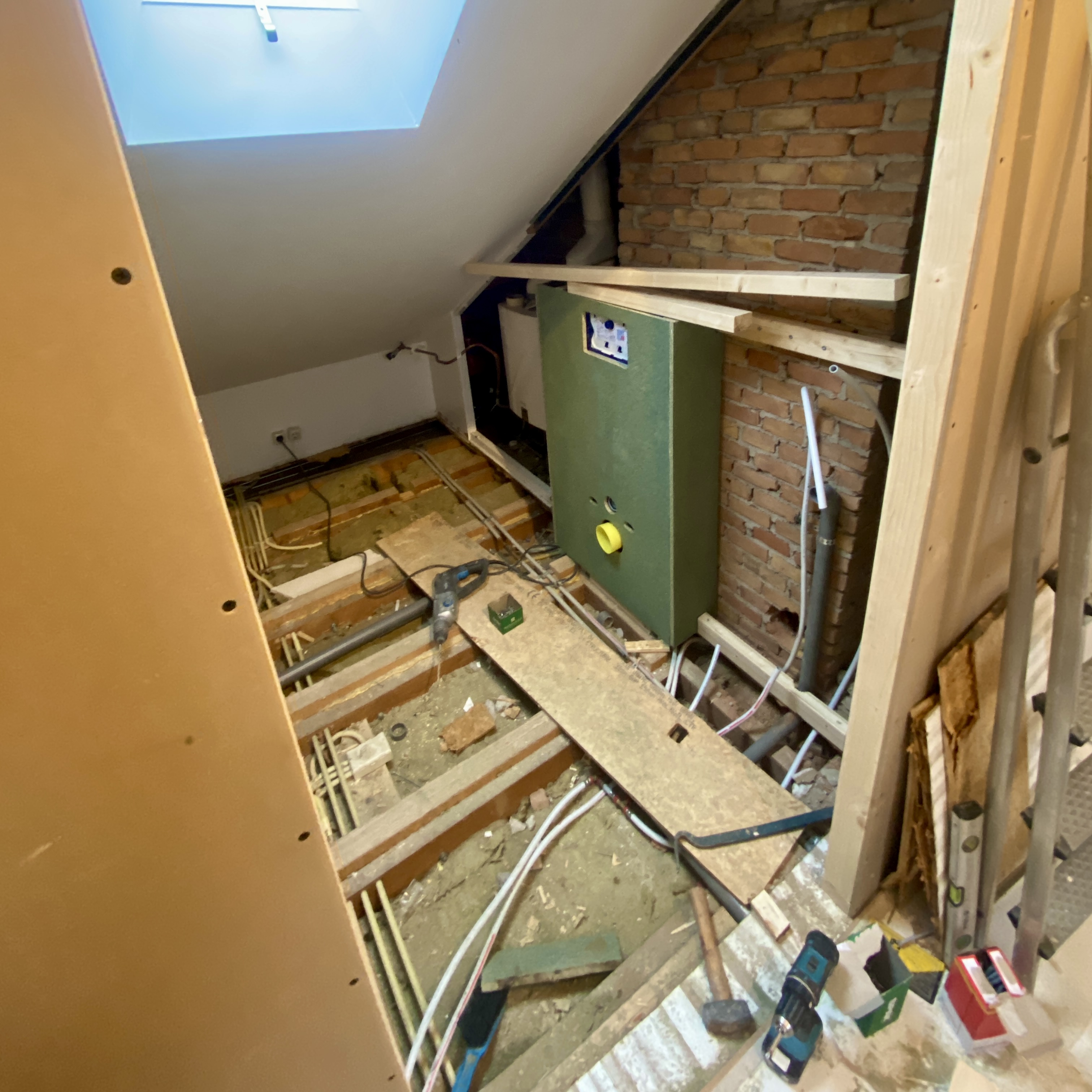
Our home wasn’t originally designed for the way we were using it.
Part of it was rented to tenants, while we continued living there ourselves. The arrangement worked, but there was still too much overlap between the private and shared spaces.
I decided to substantially reorganize the property.
We built private facilities upstairs, moved the laundry downstairs and renovated some of the shared facilities.
It took about three months.
It also cost considerably more than I had anticipated.
There was no guarantee that the investment would work out as planned.
But eventually it did.
Then I continued looking at how we were using the available space.
By moving our workspaces upstairs, another room downstairs became available to rent.
That allowed us to rent rooms to two tenants while continuing to live in the property ourselves.
And that’s when I noticed something.
The numbers suddenly looked different
The rent from those two rooms was enough to cover the property’s monthly mortgage and utility expenses.
That was a big realization for me.
We still had other living expenses, of course. I certainly didn’t suddenly consider myself financially independent.
But I could see something happening that I had previously understood mostly as an idea.
The home we were living in was generating enough income to cover its own main fixed monthly costs.
I hadn’t bought another property.
I hadn’t increased my salary.
I had changed how an asset we already owned was being used.
Until then, I had mostly thought of rent as additional income.
Now I could see one financial dependency disappearing.
Then circumstances changed again
At the time of the renovation, moving to Japan wasn’t part of the plan.
That possibility emerged later.
When we eventually moved, the changes we had already made to the property created another possibility. The space we no longer needed ourselves could also be rented.
What had begun as a way to make our existing living arrangement work better gradually became an income-producing property that could be managed from another country.
I couldn’t have planned that entire sequence because I didn’t know it was coming.
One decision simply created possibilities for the next one.
So when did I become financially independent?
I still don’t know.
Was it while I was building investments?
Was it when rental income began covering the property’s fixed costs?
Was it when I lost my job and didn’t immediately need another one?
Was it when the property generated more income after we moved?
Or was it sometime later, after enough time had passed for me to realize that employment had simply stopped being necessary?
There wasn’t one morning when I looked at a number and announced:
I’ve made it. I’m financially independent.
There were smaller moments instead.
One expense no longer needed my salary.
Another source of income appeared.
An existing asset began doing more.
Employment disappeared.
Years passed, and I didn’t return to it.
Somewhere along the way, enough dependencies had disappeared that working for someone else was no longer financially necessary.
I only recognized that afterward.
Financial independence wasn’t the same as financial freedom
I think this also explains why the words I used changed over the years.
Originally, I called what I wanted financial freedom.
Today, I see financial independence somewhat differently.
For me, financial independence means that I don’t have to work for someone else in order to sustain my life.
It doesn’t mean I never work.
It doesn’t mean I never earn money.
It doesn’t mean nothing can go financially wrong.
And it certainly doesn’t mean I retired early.
It simply means employment is no longer a financial necessity.
Financial freedom is what that independence makes possible.
It gives me greater choice over what I do with my time and which directions I decide to explore.
Financial resilience is something different again.
Investments can fall. Rental income can disappear. Unexpected expenses happen. Circumstances change.
Having different sources of income, reserves and fewer financial dependencies can make an independent position more resilient.
So today I think of the three ideas quite simply:
Financial independence removes a necessity.
Financial resilience helps protect that position.
Financial freedom expands the choices available within it.
I understood it after I lived it
When I first wanted financial freedom, I couldn’t have described exactly what my future would look like.
Too many things hadn’t happened yet.
I didn’t know I would lose my job.
I didn’t know I would invest part of the transition payment into reorganizing our home.
I didn’t know the renovation would cost more than expected.
And I didn’t know we would eventually move to Japan.
I couldn’t plan those circumstances.
What I could do was gradually create more possibilities.
Invest.
Develop additional sources of income.
Make better use of an asset I already owned.
Take some calculated risks.
Then, when circumstances changed, I had more choices available.
Perhaps that’s why I can’t remember when I became financially independent.
I was too busy living through the changes to notice exactly when it happened.
Only looking backward can I see that somewhere along the way, working for someone else stopped being something I needed to do.
I didn’t know when I became financially independent.
I only realized later that I already was.





Leave a Reply