
When I first started gardening at our home in Gifu, I didn’t really know much about pruning trees and shrubs.
I simply removed dead branches and cut away whatever didn’t look right to me.
I had become interested in Japanese cloud pruning, or niwaki, and I liked the appearance of trees with clearly defined branches and foliage arranged into interesting shapes.
So I began experimenting.
Sometimes I trimmed a little. Other times I pruned quite heavily, particularly when a tree or shrub had grown too large and I wanted to bring it back to a manageable size.
I didn’t always know how the plants would respond.
But over the following seasons, I watched them grow again.
Some developed new shoots quite vigorously. Others responded much more slowly. And sometimes the regrowth wasn’t at all what I had hoped for.
Then I would try something different.
Gradually, I began recognizing patterns in how different plants responded to pruning.
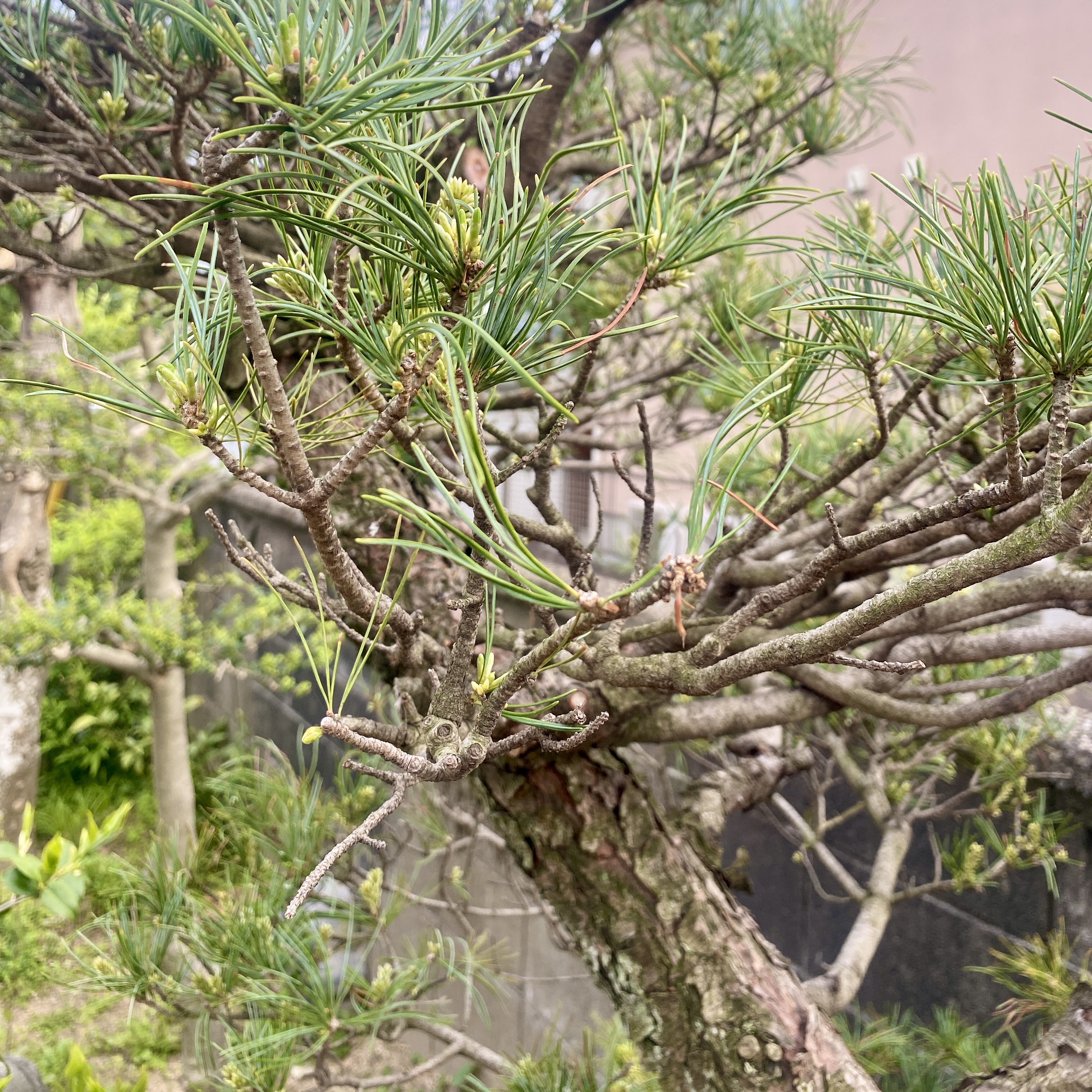
One example is our Japanese black pines.
I noticed that when three new shoots developed from the same area of a branch, the middle one would often grow straight ahead and become the strongest.
If I left it alone, it could develop into another long branch, eventually producing more shoots of its own.
But that wasn’t necessarily the shape I wanted.
So I began removing the dominant middle shoot and allowing the two side shoots to continue developing.
Over time, I could create more interesting branching patterns rather than allowing one long branch to keep extending outward.
What interested me wasn’t simply the appearance of the branches.
I began realizing that removing a branch didn’t mean stopping the tree from growing.
The tree would continue developing through the branches and shoots that remained.
Of course, the way a tree responds depends on many things, including its species, available light, and the timing and extent of pruning.
But through observation, I was learning how my decisions could influence its future growth.
I also began paying more attention to thinning.
Instead of allowing a dense collection of branches to develop, I would selectively remove some so that sunlight could reach more of the remaining foliage.
I wanted the canopy as a whole to receive sufficient light rather than having a few dominant branches overshadow everything beneath them.
This gradually changed the way I looked at individual branches.
A particularly vigorous branch wasn’t necessarily one I wanted to preserve.
Sometimes removing it allowed the rest of the plant to develop into a more balanced and interesting shape.
And eventually I began looking beyond the individual plant.
Our garden contains many different trees and shrubs, some of which had been growing there long before I moved to Japan.
They don’t exist independently of one another.
One tree can overshadow another. A shrub can become too large for the space it occupies. And plants that might look attractive individually don’t necessarily fit well together.
I started considering how everything looked from the house, how much daylight reached different areas, and how the trees and shrubs related to one another.
That also meant making some more substantial decisions.
There were old shrubs and trees that no longer seemed to be growing well or simply didn’t fit the garden I wanted to develop.
Some I cut down completely, removing the remaining roots as well.
It wasn’t always about preserving what was already there.
Sometimes removing an entire plant made more sense than repeatedly trying to keep it under control.
As a result, the plants that remain have more space, and I can manage their size and shape more easily.
The garden has gradually become more intentional in its appearance.
Not because I had a complete design in mind when I started, but because I learned what I wanted through working in it.
And I expect that will continue to change.
What I find interesting about this process is that I originally thought of pruning mainly as cutting things away.
I was removing branches, shortening shoots, thinning foliage, and occasionally cutting down entire trees.
But I no longer see it simply as removing growth.
I’m influencing where and how the remaining plants can develop.
The growth itself is something the plants do.
I can observe it, work with it, and make decisions based on what I’ve learned, but I can’t determine exactly how every branch will grow.
That understanding also reminded me of something I learned through my yoga practice.
Through the kriyas, I was taught about cultivating and harnessing life energy.
I remember Sadhguru explaining the idea with an analogy of increasing the brightness of a light bulb. As the light becomes brighter, we can see more clearly and farther than before.
That’s how I remember the explanation, rather than his exact words.
I don’t think the biological processes of a tree and the experience of practicing yoga are the same thing.
But I recognize a similarity in the idea of cultivation.
With pruning, I’m not trying to prevent a plant from growing. I’m learning how to work with its natural growth and influence the shape it develops.
And what matters to me now isn’t necessarily the strength or direction of any single branch.
It’s how that branch contributes to the entire plant, and how the plant contributes to the garden around it.
I didn’t arrive at this understanding by studying a theory of gardening.
I arrived at it by cutting branches, watching what happened, making mistakes, and trying again over several seasons.
And there’s still plenty I don’t know.
Every time I prune something, I make a decision about how I would like it to develop.
Then I have to leave the growing to the plant.
And wait to see what happens.





Leave a Reply