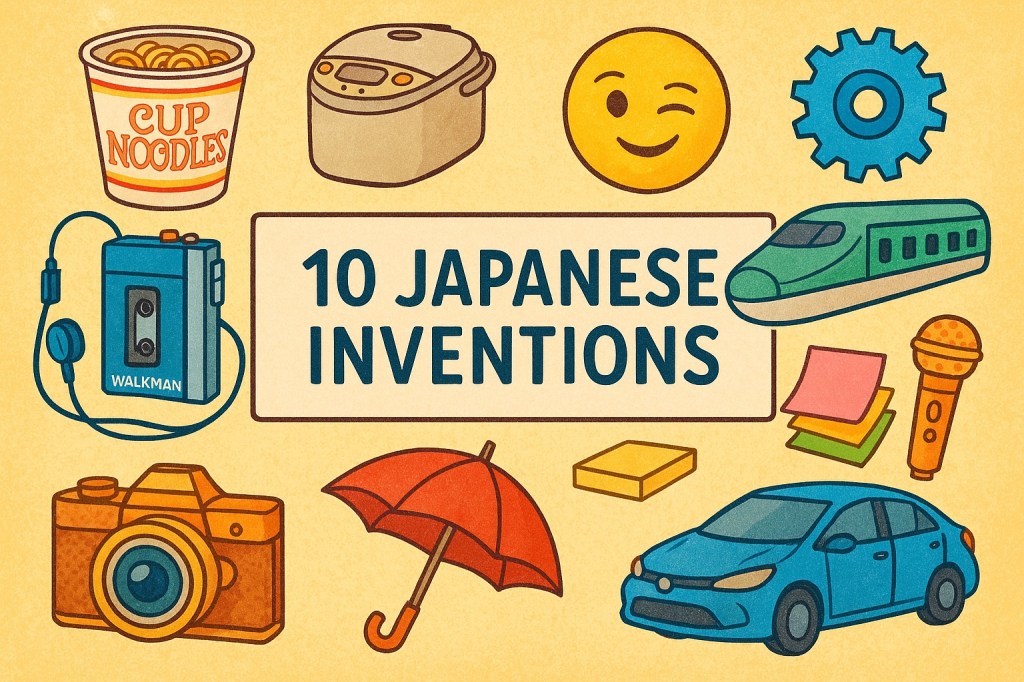
When people think of Japan, it’s usually sushi, samurai, anime, or maybe bullet trains. And sure, Japan has those. But some of the most important things we use in daily life also started there — and most of us never even realized it.
I’ve bumped into these inventions over the years without ever connecting them back to Japan. So here’s a list of 10 Japanese creations that might surprise you — ranked from the biggest “Wait, really?!” to the ones that make a little more sense once you think about it.
🥇 1. Flash Memory (1980s, Toshiba)
That tiny USB stick in your pocket? The memory card in your camera? The SSD in your laptop? All thanks to flash memory, invented by Fujio Masuoka at Toshiba in the 1980s. I can’t imagine modern life without it — yet most people never realize it came from Japan.
🥈 2. Blue LED (1990s, Japan)
LED lighting is everywhere now — in your lamp, your TV, your phone. But before the 1990s, it wasn’t possible to make bright white LEDs. Japanese scientists Isamu Akasaki, Hiroshi Amano, and Shuji Nakamura figured out the secret: the blue LED. It was such a breakthrough they won the Nobel Prize.
🥉 3. QR Code (1994, Denso Wave)
We scan them without thinking — menus, tickets, payments. But the QR code was invented in 1994 by Masahiro Hara at Denso Wave, originally to track car parts in Toyota factories. I love that something so simple and practical ended up changing the whole world.
4. Selfie Stick (1983, Minolta)
Here’s a fun one. Before smartphones, Hiroshi Ueda at Minolta invented a selfie stick for compact film cameras in 1983. It didn’t catch on back then — but decades later it became the ultimate travel accessory. Japan was thinking selfies before selfies were a thing.
5. Capsule Hotels (1979, Osaka)
The first capsule hotel opened in Osaka in 1979. Rows of tiny pods, stacked like honeycombs, offering affordable sleep in the middle of the city. It’s futuristic and a little quirky — very Japanese. Today you see capsule-style hotels all over the world.
6. Automatic Rice Cooker (1955, Toshiba)
Rice is central in Japan, but cooking it used to be a headache — often uneven or burnt. Toshiba changed that in 1955 with the first automatic rice cooker. It wasn’t just a gadget; it reshaped everyday life in Japanese homes and beyond.
7. Pocket Calculators (1970, Sharp)
Before Sharp launched its small EL-8 calculator in 1970, calculators were bulky machines. Suddenly, math became portable — in your hand, in your pocket. Another quiet revolution that started in Japan.
8. The First Laptop (1981–82, Epson HX-20)
The Epson HX-20 is often called the world’s first laptop. It had a tiny screen, a keyboard, rechargeable batteries, and even a little printer. In 1981, this was groundbreaking — and it set the stage for the laptops we can’t live without today.
9. The First Electronic Still Camera (1981, Sony Mavica)
Sony’s Mavica was announced in 1981 as the first electronic still camera. No film, just magnetic disks to store images. Not fully “digital” yet, but it was the bridge that carried us into the world of digital photography.
10. The First CD Player (1982, Sony)
Compact discs were a joint Sony–Philips project, but the first CD player sold to the public — the Sony CDP-101 in 1982 — came out of Japan. That moment kicked off the digital music revolution.
Wrapping It Up
Japan is full of surprises. It’s not just samurai and sushi, but the quiet, invisible inventions we use every day. Flash memory, rice cookers, QR codes — they’re all around us, woven into daily life.
Next time you scan a QR code, type on a laptop, or plug in a USB stick, you’ll know: you’re touching a little piece of Japanese creativity.
👉 Which one surprised you the most? For me, it’s a tie between the flash memory and the selfie stick — one changed technology forever, the other just makes me smile.
Sources & References
- Flash memory invented by Fujio Masuoka at Toshiba (1980s) — IEEE Spectrum
- Blue LED (Akasaki, Amano, Nakamura, 1990s) — Nobel Prize Official
- QR code by Masahiro Hara at Denso Wave (1994) — Denso Wave Official
- Selfie stick (Hiroshi Ueda, Minolta, 1983) — The Guardian
- Capsule hotel (Osaka, 1979) — BBC Travel
- Automatic rice cooker (Toshiba, 1955) — Toshiba Science Museum
- Pocket calculators (Sharp EL-8, 1970) — Computer History Museum
- Epson HX-20, world’s first laptop (1981) — Epson History
- Sony Mavica electronic still camera (1981) — Sony Global
- Sony CDP-101, the first commercial CD player (1982) — Sony Global History







 Experiences - Life - Inspiration 🇨🇭🇯🇵
Leave a reply to Rolf Cancel reply