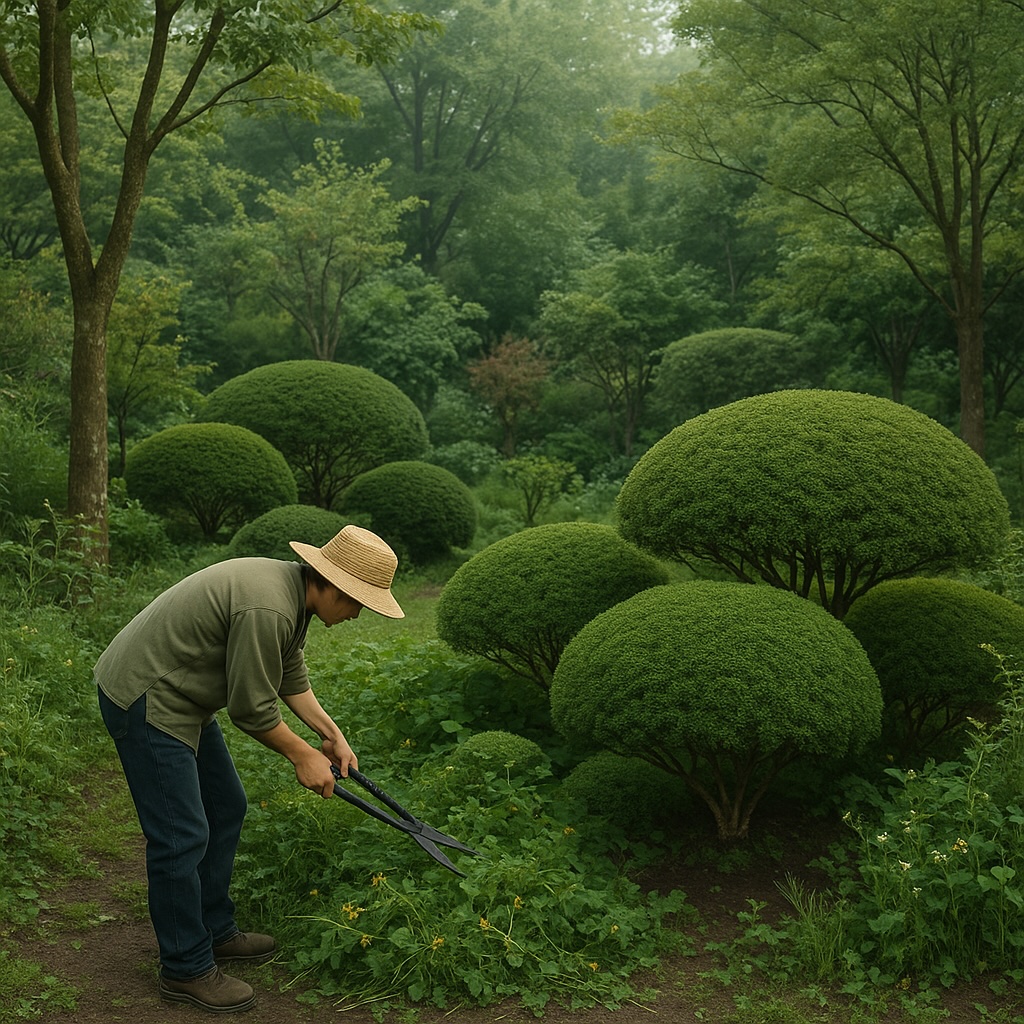
The heat and humidity of summer kept me away from the garden. Just stepping outside would soak my shirt, and the air felt heavy like it wanted to press me back indoors. So I stopped tending to the plants altogether. I let everything grow — wild, unchecked, undisturbed.
At first, it was out of necessity. But over time, I became curious. I wanted to see what would happen if I just left things alone. What kind of plants would emerge? Which would take over? Which would disappear without a trace?
Now, as the mornings are getting cooler again, I feel that familiar pull to go outside in the early hours, to pick up my tools and reconnect with the space that had grown shut in silence.
Learning by Watching
What I discovered over these months is that the garden has its own story to tell, if I’m willing to listen. Some plants returned with grace. Others spread aggressively — evasive, tangled, and climbing over everything else. Left alone, they had no sense of boundaries. But even those, I welcomed at first. I wanted to understand their nature before cutting them back.
Now, it’s time to trim. To reintroduce gentle shape and rhythm.
I’ll use my big shears and begin rounding the shrubs in a karikomi style — those soft, cloud-like shapes that soothe the eye. I’ll cut away dead or entangled branches in the trees, allowing them to breathe again. Everything I trim, I’ll mulch or compost. Nothing is thrown away. Everything goes back into the soil. A quiet cycle of return.
Not Quite a Japanese Garden
My garden doesn’t look like the ones my neighbors keep. Their spaces are pristine — carefully shaped pines, raked gravel, seasonal flowers arranged like still-life paintings. There’s a sense of perfection, of discipline. I admire it, but it’s not my way.
I want a garden that grows itself.
Not in chaos, but in harmony. Not in neglect, but in natural rhythm.
My only goal is to keep the soil healthy and the garden alive — to shape it lightly when needed, to let it be when it’s thriving. If a plant grows well and pleases the eye, it stays. If not, I let it grow until I can harvest it as mulch or compost. Every plant has its purpose, even the unwanted ones.
The Aesthetics of Intuition
People ask what kind of gardening style this is. I’m not sure. I’m not following a rulebook. I don’t have a master plan.
I just look at a combination of plants or the shape of a tree, and something in me knows whether it feels right or not. It’s not logic. It’s not theory. It’s more like… intuition. A sense of ease or friction. When it feels right, I leave it alone. When it doesn’t, I gently intervene.
And I always keep the seasons in mind.
I don’t want to plant new flowers every year or every season. My hope is to encourage plants that return — perennials and bulbs that know when it’s time to bloom. I want a garden where something beautiful returns in each season, without me having to force it.
A Garden in Conversation
There’s still a part of me that wonders: Will this really work? Can a garden grow mostly on its own, with just trimming and composting as guidance? I’m not entirely sure. But I do know that trying to control everything has never brought me peace.
This approach — letting things grow, then shaping lightly — feels like a conversation. I don’t impose. I respond. I don’t dominate. I collaborate.
In the end, I don’t want to garden just to show off a tidy yard. I want to be in relationship with the space. To feel its changes. To adapt. To witness.
Maybe that’s not a style with a name. Maybe it doesn’t fit into anyone else’s idea of beauty.
But it feels honest. And for now, that’s enough.








 Experiences - Life - Inspiration 🇨🇭🇯🇵
Leave a comment