
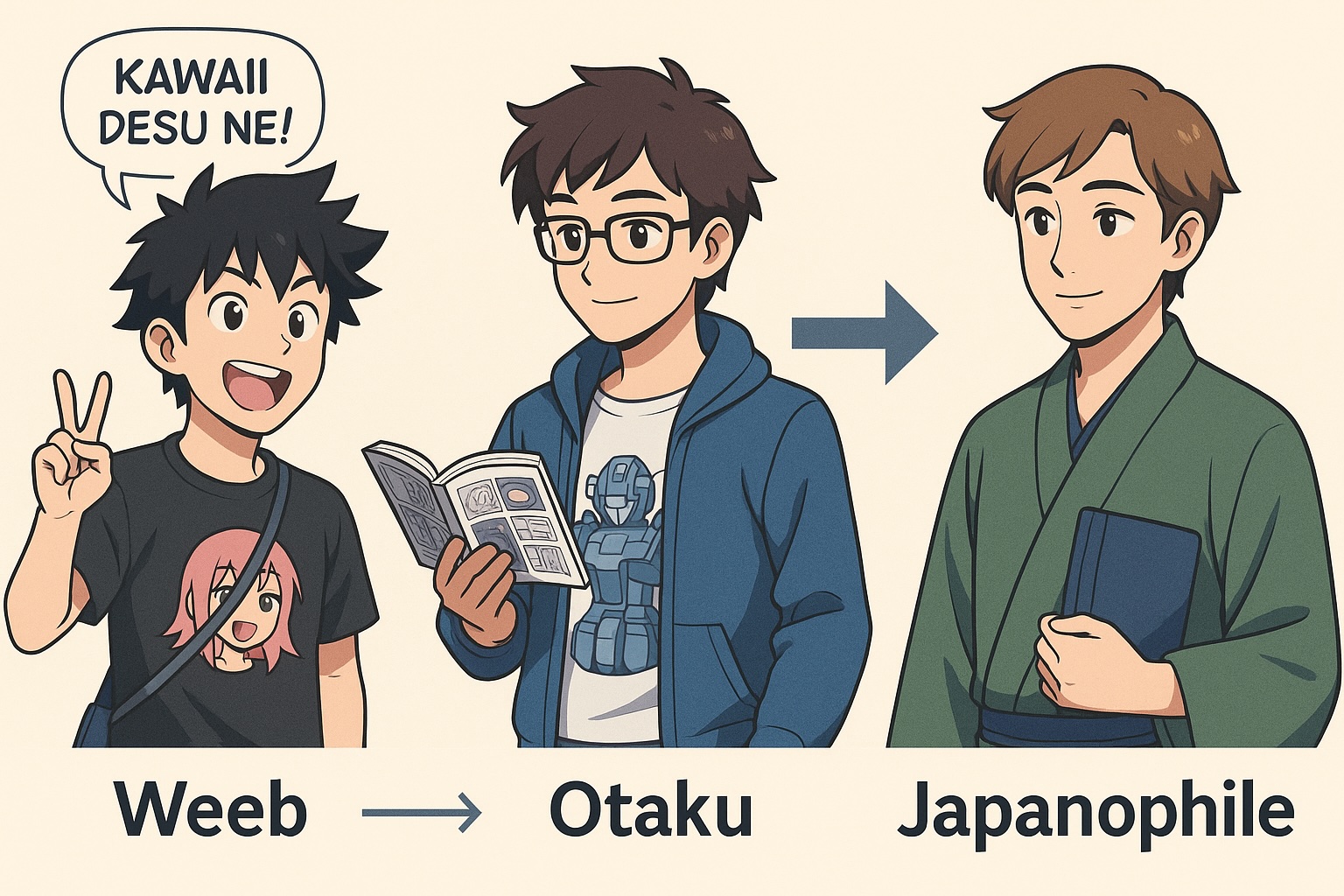
The internet loves its slang, and if you’ve spent any time in anime or manga circles, you’ve probably heard the term weeb thrown around—sometimes as a joke, sometimes as an insult. But what exactly is a weeb, and how does it differ from an otaku or a Japanophile? And what’s this about a Weeb Economy that could “save” Japan? Let’s break it all down.
1. What Is a Weeb?
A weeb (short for weeaboo) is someone—usually not Japanese—who’s overly obsessed with Japanese culture, especially anime, manga, and video games.
We’re not just talking about enjoying a Studio Ghibli movie or wearing a cute Totoro hoodie. We’re talking about:
- Using random Japanese words in everyday conversation (“Kawaii desu ne!”) whether they fit or not.
- Romanticizing Japan as a flawless paradise without acknowledging the reality of living there.
- Letting fictional portrayals completely replace real cultural understanding.
The term started as an insult online, but among friends, it’s often used jokingly or self-deprecatingly. Still, the key thing about a weeb is excess—the obsession is loud, unbalanced, and often a little cringey.
2. What Is an Otaku?
In Japan, otaku simply means someone with an intense interest in a particular hobby. It could be anime, video games, trains, photography—you name it. Outside Japan, the term usually refers to someone deeply into anime and manga.
The main differences between an otaku and a weeb:
- Otaku focus on the hobby itself, not the entire culture.
- They may know a lot about Japan because of their hobby, but they’re not trying to be Japanese.
- While “otaku” can have a slightly negative connotation in Japan (implying social awkwardness), it’s generally not as loaded as “weeb” is online.
Think of an otaku as a serious, passionate fan, but without the same level of cultural overreach that a weeb might have.
3. What Is a Japanophile?
A Japanophile is someone who genuinely appreciates Japanese culture as a whole—language, history, traditions, art, cuisine—beyond just pop culture.
They might:
- Study the Japanese language in depth.
- Learn about Shinto, Zen gardens, and traditional crafts.
- Enjoy Japanese cinema from Kurosawa to contemporary indie films.
The difference from a weeb is respect and balance. A Japanophile loves Japan while acknowledging its complexity and imperfections, seeing it as a real country with a rich, multifaceted culture—not just an anime wonderland.
My Own Journey: From Weeb-Like Fascination to Japanophile Respect
If I had to place myself on this spectrum, I’d say I’ve traveled through all three worlds in my own way.
As a kid, I was surrounded by Japanese pop culture. I devoured Saint Seiya, Fist of the North Star, Akira, Ghost in the Shell, Sword Art Online, and Macross. I played countless Final Fantasy games, spent hours perfecting combos in Street Fighter, and followed long-running anime like Bleach and Dragon Ball.
Back then, my connection to Japan wasn’t about idolizing the country as a flawless utopia—it was about escapism. These stories offered larger-than-life adventures, complex worlds, and imaginative artistry that made my everyday surroundings feel small in comparison.
Over time, my passion shifted. I moved into something closer to an otaku phase, where I wasn’t just watching or playing for fun—I was diving deep into specific series, exploring their worlds, themes, and artistry with obsessive dedication.
Eventually, my interests broadened again. I began to appreciate not just the media, but Japan itself—its history, traditions, festivals, and the way modern life blends with centuries-old culture. Today, I’d call myself a Japanophile, carrying the spark from my childhood but grounding it in a real, balanced understanding of the country.
4. Enter Weeb Economy: Culture as Economic Catalyst
Econ-blogger Noah Smith takes the idea of “weebs” beyond fandom and into the realm of economic impact. In his 2025 book Weeb Economy: The Weebs Will Save Japan, he argues that global affection for modern Japanese culture can become a serious economic asset—what he terms the weeb economy.
Smith’s thesis? That fan enthusiasm—from anime and gaming to fashion and lifestyle—can help Japan attract investment and international talent. He focuses on “greenfield” foreign direct investment: foreign-led startups and new facilities that create jobs and export potential, rather than simply buying existing businesses.
He likens Japan to a cultural super-asset. The world’s fascination with contemporary Japanese life—what he calls the “modern way of life,” not just traditional heritage—makes Japan uniquely appealing for living, working, and innovation. His model even segments fans into “Core Weebs” (deeply immersed in anime and games) and “Casual Enthusiasts” (drawn to travel, design, food, and modern culture).
Why this matters:
- It highlights that being a weeb isn’t just about enjoying anime; it can be part of a global economic force.
- It shows how cultural passion can inspire real-world opportunity—shifting “weeb” from a niche identity to strategic value.
- It underscores that not all weebery is superficial—some of it may spark meaningful contributions to society.
5. Placing Weeb Economy in Context
| Term | Definition | Key Distinction |
|---|---|---|
| Weeb | Someone overly obsessed with Japanese pop culture—often criticized for stereotyping or fetishizing Japan. | A cultural fascination, sometimes excessive. |
| Otaku | A serious hobbyist deeply into anime or a specific interest, often with no broader cultural pretense. | Passion-focused hobby, less cultural overreach. |
| Japanophile | Someone who appreciates a wide array of Japanese culture—language, history, tradition—with nuance. | Balanced, respectful admiration. |
| Weeb Economist (Weeb Economy view) | A reframing: fandom becomes a tool for economic revitalization by attracting investment and talent. | Cultural enthusiasm becomes strategic value. |
6. Final Thoughts
Whether you’re quoting “kawaii desu ne!” in the middle of lunch or quietly studying Japanese calligraphy, remember: the line between “just a fan” and “someone shaping economies” can be thinner than you think. Noah Smith’s Weeb Economy shows that weeb culture—handled thoughtfully—can transcend cringe and become a driver of global connection, creativity, and even economic renewal.
Love Japan how you want, but keep it balanced. Celebrate what you enjoy, learn about the rest, and maybe—just maybe—you’ll end up part of the weeb economy without even realizing it.




Leave a Reply