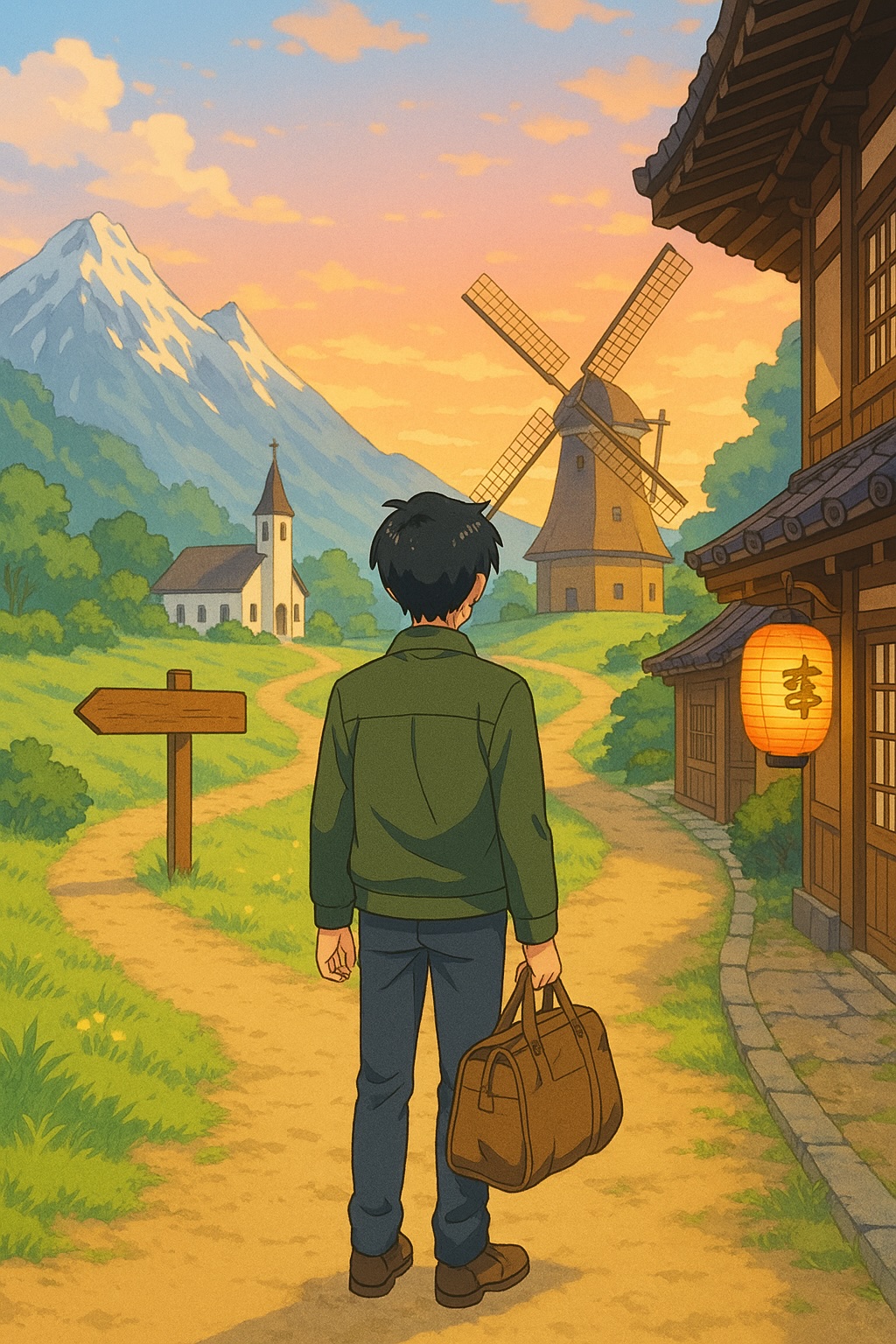
Recently, I’ve been reflecting more deeply on my life as an immigrant. The reason is simple: everywhere I turn—in Japan, across Europe, in the US—there is growing tension around immigration. Political debates, policy shifts, public fear, and media headlines paint immigrants as a problem to solve rather than people with stories, struggles, and aspirations. In Japan, where I now live, immigration has become a major topic in recent elections. In Europe and the US, protests and restrictions are becoming louder and harsher.
This climate compelled me to speak. Not from a place of politics, but from lived experience.
I was born in Switzerland to a Thai mother who had immigrated there while pregnant with me. From the beginning, my identity was a blend—Thai roots with a Swiss beginning. As a child, I didn’t think much of cultural duality. Switzerland was home. But even then, my mother’s quiet Thai mannerisms, her food, her language—they were part of me, subtly shaping how I saw the world.
When I was fifteen, we left Switzerland and moved to the Netherlands. Suddenly, I was the immigrant. Again. A new language, new norms, new expectations. I remember standing in Dutch classrooms trying to make sense of words that felt like noise. I remember observing how Dutch people interacted—direct, open, efficient. It was different from Swiss formality and very different from Thai warmth. But I adapted. Slowly, surely. I studied, worked, made friends, and built a life. I lived in the Netherlands for thirty years. I became Dutch in spirit while still holding onto the roots of my origin.
Then came Japan. Once again, I chose to start anew. This time as an adult. With more life experience—but also more layers of identity. Moving to Japan meant resetting everything. Language. Social cues. Bureaucracy. Even the smallest things like how to bow correctly or when to speak could feel like a test. And yet, despite the friction, I adapted again. Because that’s what immigrants do.
When I immigrated to the Netherlands, I was determined to learn and master the Dutch language as fast as possible. This helped me not only understand the language but also the culture and social mannerisms that are so deeply tied to it. In many ways, the Netherlands had a well-established and efficient integration system, making it relatively easier for foreigners like me to find a place in society.
In Japan, however, integration isn’t as prevalent or clearly structured. The country has always been largely homogenous and geographically isolated, and the idea of a multicultural society—so familiar in the Netherlands—doesn’t quite apply here in the same way. It’s something one must be aware of when arriving in Japan: the path to integration is often unspoken, slower, and more nuanced.
Wherever I go in Japan, and whomever I interact with in daily life, there is almost always a lack of full understanding. Japanese is a very difficult and totally foreign language for me to comprehend. Unlike Dutch, which shares European roots with Swiss German and felt somewhat familiar, Japanese is a completely different system of communication. Learning it is a challenge—but not an excuse to avoid trying. I attend Japanese lessons regularly, and yet, even after two years, hiragana, katakana, and especially kanji still feel like a mystery. The learning process is immensely slow. Misunderstanding is inevitable, and not understanding is still a regular part of my daily experience.
But I keep going. Because adapting—however slow or imperfect—is the immigrant’s path.
I must also say that I feel genuinely embarrassed by misbehaving foreigners who visit or live in Japan. Their behavior not only disrespects local norms but also undermines the silent, respectful effort many of us make to integrate. I believe that harsh penalties and intervention by local authorities are completely justified and necessary. Misbehaving foreigners should be disciplined just as much as misbehaving local Japanese—no differently. I am also well aware that Japanese people often refrain from confronting foreigners out of politeness or discomfort. But I encourage them to speak up when their manners, space, and culture are disrespected. It’s essential for the self-preservation of their way of life.
Throughout my life, I’ve carried my heritage with pride, but I’ve never tried to impose it on the cultures that welcomed me. I’ve always believed that integration isn’t about abandoning who you are—it’s about learning who others are, and finding harmony in that.
This mindset doesn’t come easy. It takes humility. It takes willingness to be wrong, to feel out of place, to not know the rules. It takes years of quiet effort that often goes unseen by locals who’ve never had to do the same.
And that’s where some of the friction comes from. In societies where most people have only lived within their own culture, it can be hard to understand the immigrant experience. They may see us as outsiders who refuse to adapt, when in fact many of us bend ourselves daily to fit in—to contribute, not to take.
I believe the only people who truly understand this are those who’ve lived it. Who’ve had to relearn how to belong, again and again. Who’ve had to carry their cultural heritage quietly while learning new ways to be accepted.
Being an immigrant isn’t just about moving countries. It’s about becoming fluent in humanity. It’s about learning that identity is not a fixed label, but a living bridge between cultures.
So here I am—Thai by blood, Swiss by birth, Dutch by experience, and Japanese by choice. I don’t belong to one place. I belong to all of them. And maybe, through that journey, I’ve come to understand that true belonging is not where you’re from—but how you choose to live among others.




 Experiences - Life - Inspiration 🇨🇭🇯🇵
Leave a comment