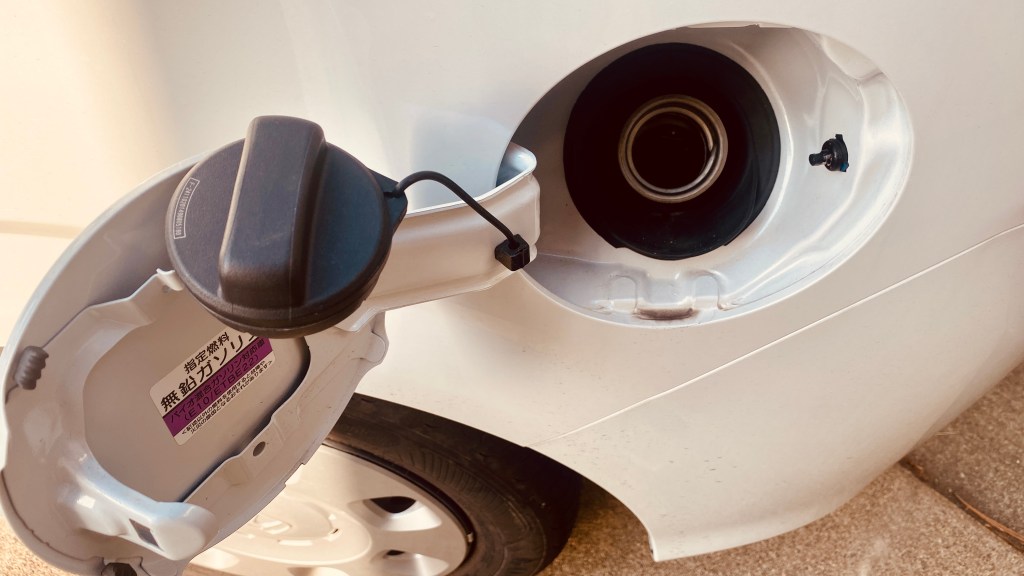
Last December, I was standing at a gas station in the Netherlands, staring at the price display a little longer than necessary.
You probably know that moment. You are not even shocked anymore. Just quietly disappointed. You pick up the nozzle, start fueling, and try not to convert the numbers too precisely in your head because you already know it will hurt.
Coming from Japan, it hurt a bit more than usual.
Back in Japan, gasoline had always felt relatively reasonable to me. Not cheap, but normal. Definitely cheaper than what I remembered from my time in Europe. And because I earn in euros and spend in yen, Japan has had this strange side effect for me for years. Many everyday things feel like a bargain, even when I know very well they are not necessarily cheap for everyone living here.
Still, standing there in the Netherlands in December, watching the numbers climb, something in my internal price compass reset itself.
Then I came back to Japan.
And something interesting happened.
Gasoline was already feeling cheap by comparison. But over the following weeks, it started getting even cheaper. Not dramatically from one day to the next, but enough that I began to notice it. Enough that it started to feel a little unreal.
At first, it felt like one of those quiet price changes you only notice when you stop and think. Then I realized that, from my perspective, this was not just a small drop. It felt like a double discount.
One discount came from policy and markets. The other came from my own point of reference.
We like to believe we judge prices objectively. In reality, we almost never do. We always compare. To what we paid last year. To what we pay in another country. To what we remember as normal.
For me, that reference point had just been forcefully updated in Europe.
So what actually changed in Japan?
In simple terms, several things happened at once. The Japanese government finally abolished a provisional gasoline tax that had existed for decades. At the same time, subsidies were used to soften the transition so prices would not jump around too wildly. Global oil prices also eased. And on top of that, the yen remains weak against the euro.
All of this together pushed prices down at the pump.
On paper, this is economics and policy.
In daily life, it feels like something else entirely.
It feels like standing there, filling up the car, and thinking, this cannot be right. This feels too cheap.
Of course, this is where perspective becomes tricky.
For many Japanese families, gasoline is still expensive. Every yen matters. A few yen more or less per liter changes the monthly budget. My experience is shaped by the strange privilege and distortion of earning in one currency and living in another.
When you live between countries, prices stop being absolute. They become relative stories you tell yourself.
In yen, gasoline has gone down a bit.
In euros, it feels like a landslide.
The really interesting part is how quickly the mind adapts.
A few months ago, prices in Japan felt normal. After visiting Europe, they felt cheap. After the recent drops, they suddenly feel almost unreal.
Nothing magical happened. The world did not suddenly become generous. My measuring stick changed.
Travel does that. Living abroad does that. It constantly rewires your sense of what is expensive, what is cheap, and what is normal.
It also reminds me how much of our daily reality is not shaped by numbers, but by comparison.
The same price can feel oppressive or generous depending on where you stand and what you compare it to.
In the end, gasoline did not just get cheaper.
My point of view did.
And maybe that is a useful reminder for many other things in life too. Sometimes it is not the world that changes first. It is the lens through which we look at it.



 Experiences - Life - Inspiration 🇨🇭🇯🇵
Leave a comment