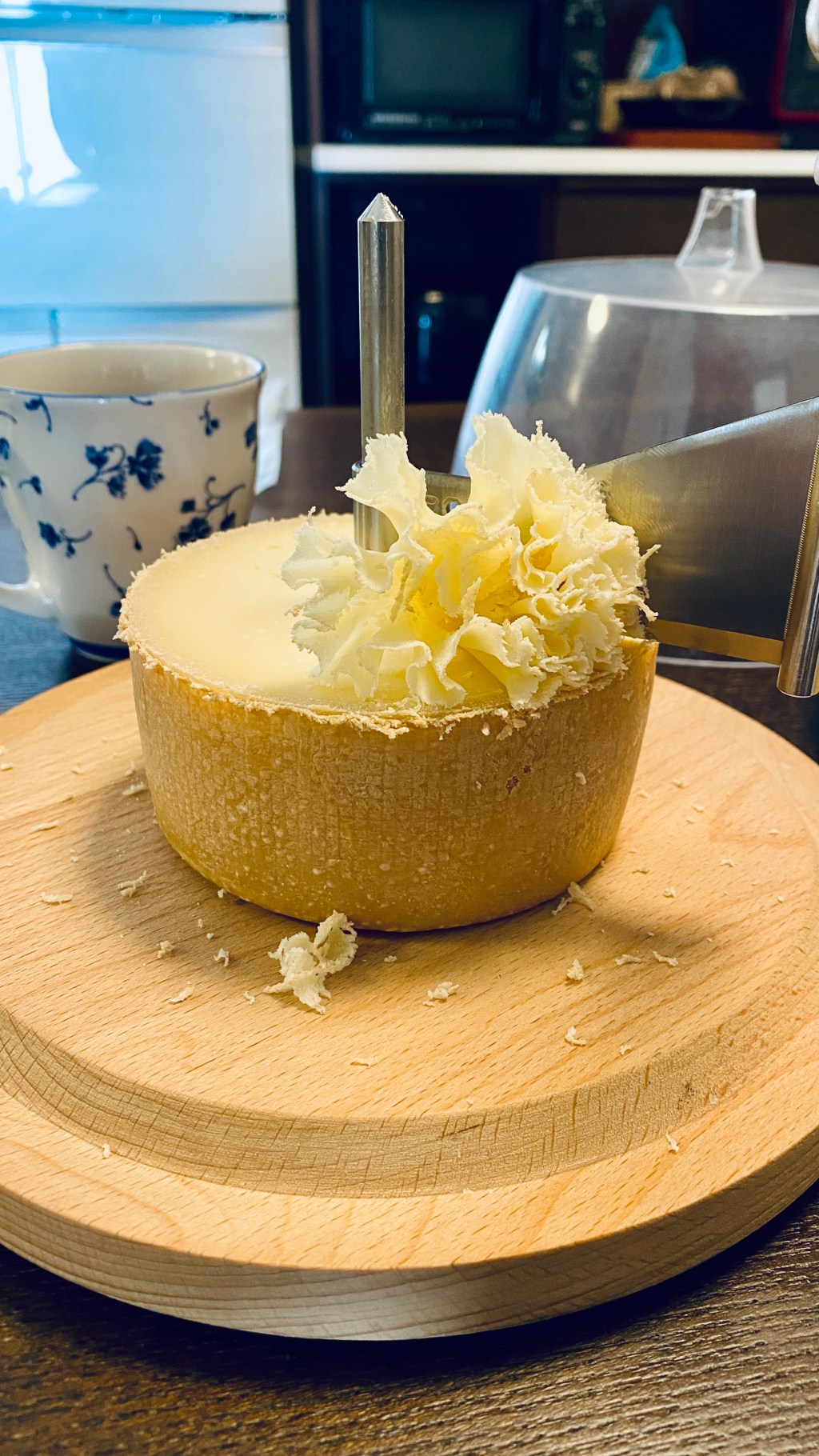
Today I unpacked a small object that traveled with me from the Netherlands to Japan. A Swiss cheese curler. Along with it, a piece of Tête de Moine that somehow survived the journey home.
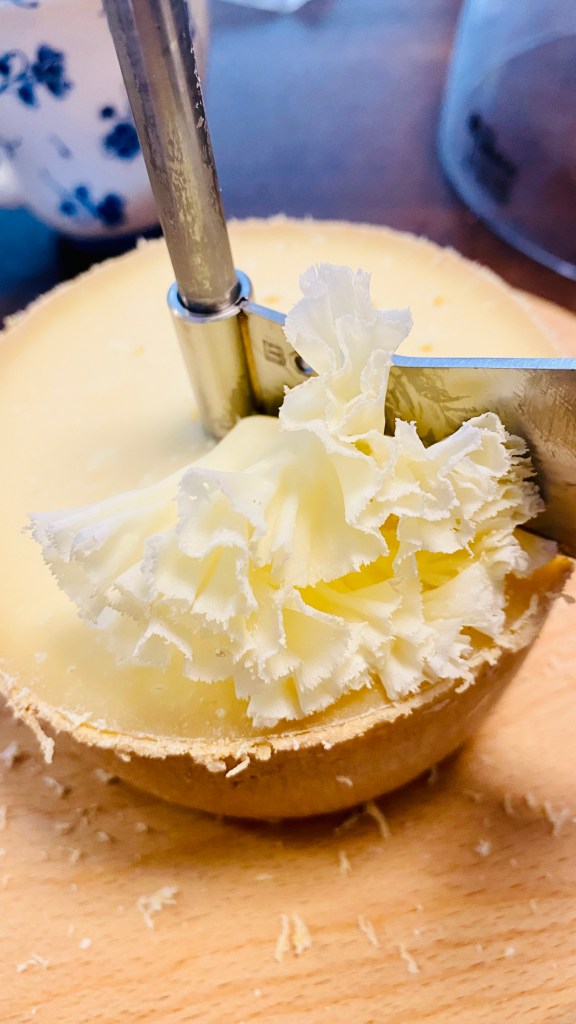
As I turned the handle and watched the cheese form those delicate little rosettes, the familiar nutty aroma filled the room. Tête de Moine has always been my favorite Swiss cheese. Ever since a classmate from the Swiss Jura introduced me to it, it has been my personal benchmark for what a simple, honest cheese can be.
For me, the perfect way to enjoy it has not changed in all these years. A few green grapes. Some nuts. And, if possible, a glass of Swiss white wine. In my mind, that is not just a snack. That is a small Swiss delicacy.
The curler itself is made by Boska, a Dutch company that has been making cheese tools since the end of the 19th century. That felt a little funny at first. This is Swiss cheese. The tool is Dutch. And I am standing in my kitchen in Japan.
The Netherlands does not even make Tête de Moine. So why is a Dutch company making a Swiss cheese tool?
Then it occurred to me that Boska is not really a Dutch cheese company. They are a cheese tools company. The Netherlands has been a trading hub for centuries, and cheese has always traveled across borders there. Boska does not make tools for one country’s cheese. They make tools for people who love cheese.
And good ideas, like good cheese, do not stay inside borders.
That thought made me curious about the tool itself. It feels like one of those objects that has always existed. Like a spoon or a corkscrew. But of course, it has not.
Before the cheese curler existed, Tête de Moine was eaten by scraping it with a knife. It worked, but it required some skill and patience. It was slow, and it never really produced the same light, airy texture you get from those thin curls.
In 1982, in the Swiss Jura, a precision mechanic named Nicolas Crevoisier decided there must be a better way.
He was not trying to reinvent cheese. He was simply trying to make it easier and more enjoyable to serve. So he experimented. He drilled a hole through the center of the cheese. Fixed it on a vertical pin. And designed a rotating blade that would shave the surface evenly.
When he turned the handle, the cheese did something unexpected. It did not just form thin slices. It curled into little rosettes. Crevoisier’s daughter noticed that they looked like girolles, chanterelle mushrooms. And that is how the tool got its name.
The girolle.
No big vision. No disruption. No world changing ambition. Just someone looking at a small everyday problem and quietly solving it with care and precision.
And in doing so, he did not just make serving cheese easier. He changed how the cheese is experienced. The rosettes are not only beautiful. They also expose more surface to the air, which makes the aroma stronger and the taste more expressive. The tool shapes the experience.
Now, decades later, a Swiss invention is made by a Dutch company, sold across Europe, and carried in a suitcase to Japan. And I stand in a Japanese house, turning a small handle and thinking about how many invisible stories are hiding inside ordinary objects.
It is easy to forget that almost everything around us was once just an idea in someone’s head.
Even a piece of cheese. Even a simple tool. Even a small moment like this.
I turn the handle once more. Another rosette forms. And for a brief moment, Switzerland, the Netherlands, and Japan meet in my kitchen.








 Experiences - Life - Inspiration 🇨🇭🇯🇵
Leave a comment