Lately, I’ve been spending a lot of time on YouTube listening to long-form conversations, especially on Diary of a CEO. There’s something about hearing people unpack their deepest ideas that sparks my curiosity.
Sadhguru’s wisdom has been a steady part of my life for some time. I’ve read his books, listened to countless talks, and even participated in his Inner Engineering and Shoonya Intensive programs. Those were the starting points of my daily yoga practices — a discipline that has turned my mornings into a grounding, joyful reset.
Yesterday, I came across a guest I had never heard of before: Donald Hoffman. He’s a cognitive scientist whose work challenges one of the most basic assumptions we hold — that we see the world as it really is. According to him, we don’t. Instead, our perceptions act more like a survival-focused user interface, showing us what’s useful for living, not what’s true.
As I listened to him explain this, I couldn’t help but imagine: What if Donald Hoffman and Sadhguru sat down for a conversation?
To my knowledge, such a meeting has never happened. But as I pictured it, I noticed surprising overlaps between their worlds.
The Scene I Imagine
In my mind, they’re seated across a small wooden table. Between them, two cups of steaming tea send wisps into the air. Hoffman speaks with a calm, precise rhythm, carefully explaining the logic behind his models. Sadhguru leans back with a knowing smile, listening deeply before answering with a story that turns the concept into lived experience.
The Common Ground
Both, in their own ways, question the default human view of reality.
- Hoffman suggests that our senses don’t show us truth, only a useful version of it.
- Sadhguru says perception is shaped — and limited — by the condition of our body, mind, and energies.
Both see consciousness not as a byproduct of matter, but as the foundation of existence itself.
- Hoffman wants to model this scientifically.
- Sadhguru wants you to experience it directly.
If They Ever Spoke, I Imagine the Takeaways Would Be:
- Our everyday perception is filtered — whether you call it an evolutionary interface or a mind-created illusion.
- Consciousness may be the foundation of reality, not just a side effect of the brain.
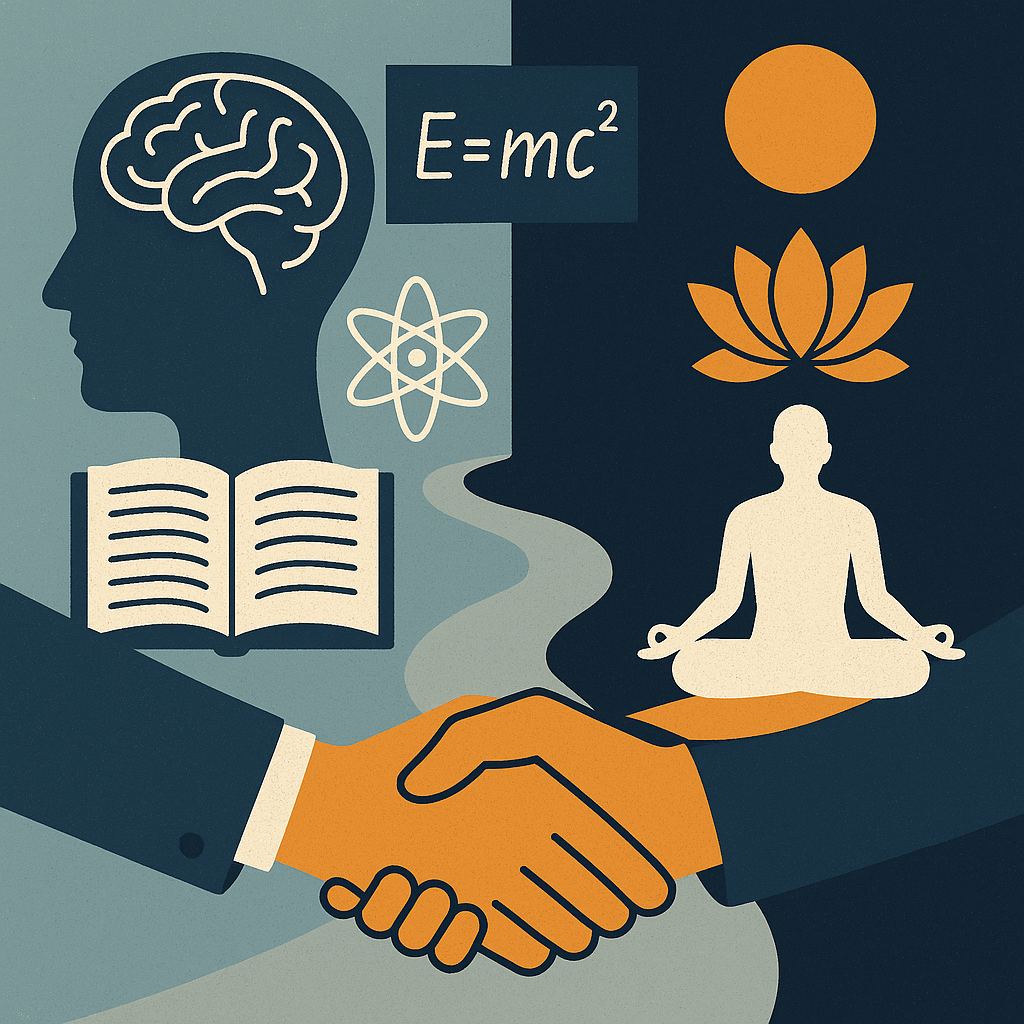
- Science and inner experience are complementary — neither is complete without the other.
Why This Matters for Us
Whether you approach truth through mathematical models or through meditation, both paths suggest that there’s far more to reality than what meets the eye. The exciting part is that we don’t have to choose one over the other. We can explore both — rigorously questioning and deeply experiencing.
For me, this imagined meeting between Hoffman and Sadhguru is a reminder that science and spirituality, often seen as opposites, can actually be allies. Both are in the business of expanding perception — one by refining our tools of measurement, the other by refining the perceiver.
And maybe, that’s the real takeaway: whatever path we choose, the most important thing is to keep walking.
If readers have never heard of Donald Hoffman before, they’ll leave with curiosity to explore his work. And if they’ve never tried Sadhguru’s teachings, maybe they’ll feel inspired to look inward. As for me, I’ll keep listening, practicing, and imagining — because sometimes, the conversations that never happened can still open doors in our minds.








 Experiences - Life - Inspiration 🇨🇭🇯🇵
Leave a comment