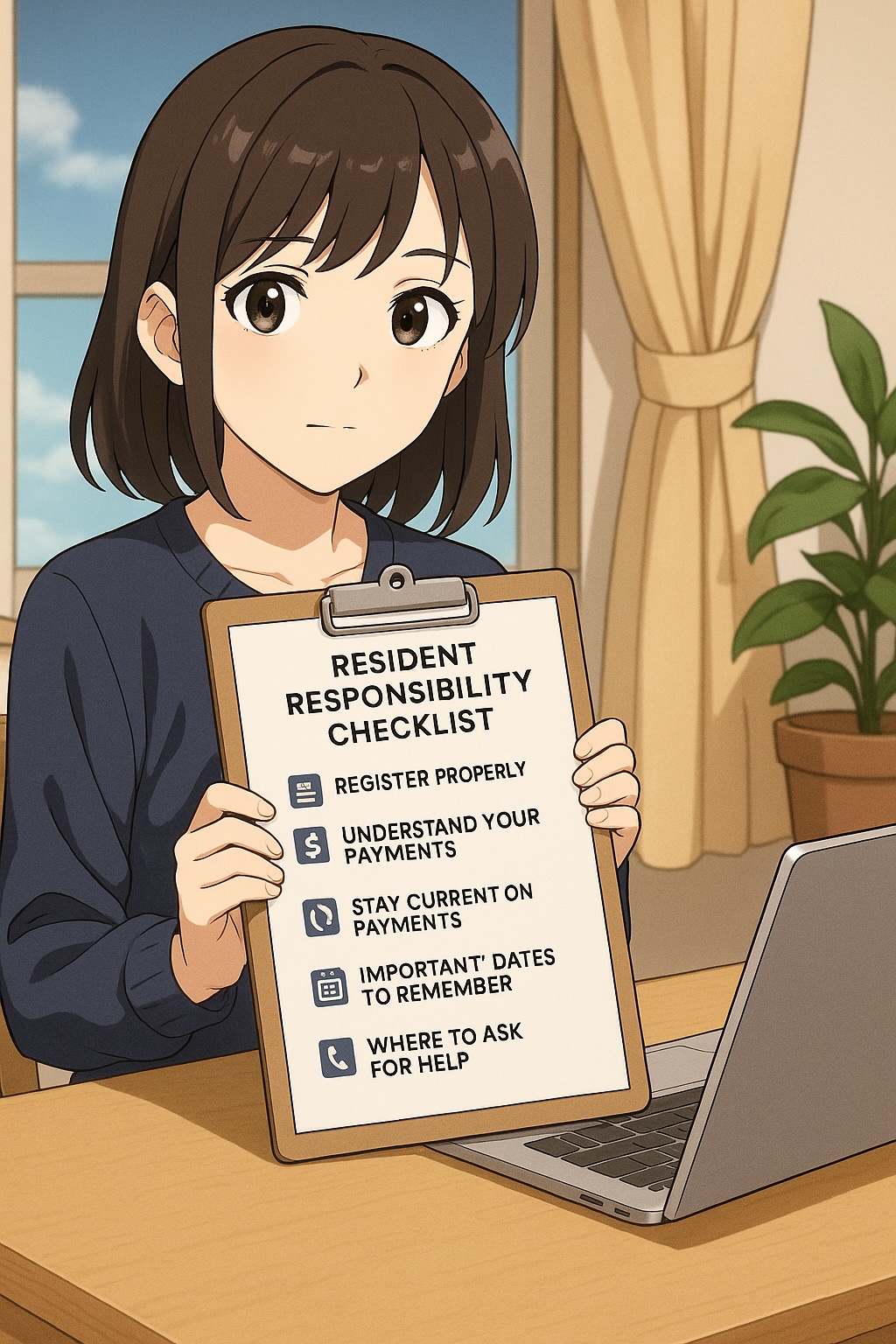
Lately, news about Japan tightening immigration rules for foreign residents behind on taxes or insurance payments has sparked a lot of reactions online. Personally, I found it surprising that this even made headlines—because to me, it seems like a no-brainer: if you’re living in a country as a guest, you should follow its laws, pay your dues, and contribute where you can. Deportation is arguably a more efficient response than fines or jail time when someone consistently ignores the rules.
But the more I looked into it, the more I realized that the real issue isn’t the principle—it’s the system. Without a clear, waterproof way to inform and support residents, even responsible people can end up in trouble without knowing it. That’s why I put together this guide—to help fellow residents avoid confusion, track their responsibilities, and stay in good standing with local authorities and immigration.
✅ Japan Resident Responsibility Checklist
For Mid- to Long-Term Foreign Residents
📘 1. Register Properly
- Register your address at the City Hall within 14 days of moving.
- Enroll in the National Health Insurance (NHI) or Social Insurance (Shakai Hoken) system, depending on your job type.
- Confirm whether you’re required to pay National Pension (Kokumin Nenkin) if not covered by your employer.
💴 2. Understand Your Payments
You may be responsible for the following payments:
- Resident tax (住民税 – Juminzei): Annual municipal tax, based on income.
- National Health Insurance premiums: Monthly or quarterly, based on income and household size.
- National Pension contributions: Flat monthly fee unless you’re exempted.
- Income tax (所得税 – Shotokuzei): Usually deducted from salary, but worth double-checking.
- Medical bills: Anything not covered by insurance (30% co-pay) must be paid by you.
💡 Tip: Ask your City Hall for a breakdown of what you’re expected to pay based on your status.
🔄 3. Stay Current on Payments
- Set up automatic payments through your bank when possible.
- Keep all receipts and payment slips—you’ll need them for visa renewals.
- Request payment certificates ahead of your visa application:
- Tax Payment Certificate (納税証明書 – Nozei Shomeisho)
- Insurance Premium Payment Certificate (保険料納付証明書 – Hokenryo Nofu Shomeisho)
📅 4. Important Dates to Remember
| Task | Timing |
|---|---|
| Income tax filing (if required) | Feb 16 – Mar 15 each year |
| Resident tax bills arrive | Around June |
| Health insurance bills | Monthly or quarterly |
| Pension exemption renewal | Annually, if applicable |
| Visa renewal window | 1–3 months before expiration |
☎️ 5. Where to Ask for Help
- City Hall: Taxes, health insurance, pension, certificates.
- Immigration Office: Visa renewals, extensions, status updates.
- NPOs / Support Centers: Translation, consultation, legal help.
- Official Guides: CLAIR Japan, GaijinPot, Tokyo Intercultural Portal.
💡 A “Waterproof” System: What Japan Should Consider
If the new rules are meant to protect fairness, a transparent and coordinated system is needed. Here’s what that could look like:
📲 Does Japan Already Have the Tools?
Yes and no. Japan’s MyNumber card system and Mynaportal offer a promising foundation, but they’re still incomplete for this purpose.
✅ What Mynaportal Already Supports:
- One ID number (MyNumber) links each resident to:
- Tax records
- Health insurance
- Pension system
- The online Mynaportal lets users:
- View limited tax and insurance info
- Apply for some documents digitally
- Download certificates with a card reader or smartphone
❌ What It Still Needs to Do:
- No full multilingual interface (mainly Japanese, limited English).
- No central dashboard showing what’s owed across all systems.
- No immigration/visa info integration.
- No real-time alerts for overdue bills or missed deadlines.
- Limited coordination between agencies (immigration, city hall, and national systems still operate in silos).
If Japan wants to enforce residency rules more strictly, then it must also provide the clarity and access residents need to follow those rules.
🧭 Final Thoughts
Following the rules and fulfilling your obligations is part of living respectfully in any country—but the system must make it possible to do so clearly and consistently. I believe this can be a win-win situation for both Japan and its growing foreign population, especially if we focus on clarity, accessibility, and fairness.
Take, for example, a foreign resident who changes jobs and moves from one city to another. They might assume their health insurance or pension enrollment carries over, not realizing they need to re-register or confirm everything at their new City Hall. A few missed letters in Japanese and suddenly, they’re behind on payments—unknowingly putting their visa at risk.
Japan’s population is shrinking, and foreign workers, students, and residents play an increasingly important role in supporting the economy and social systems. As immigration grows, clarity and support must grow alongside enforcement. Strong systems don’t just catch mistakes—they help prevent them.
If Japan wants to attract and retain globally minded, responsible residents, it needs more than just penalties—it needs tools that make it easy to follow the rules. Otherwise, we risk turning away the very people the country needs most.
🔍 Can a nation facing labor shortages afford to maintain a system where so many residents struggle just to stay informed?
📌 Disclaimer
This blog post is intended for general informational purposes only and does not constitute legal, financial, tax, or immigration advice. While every effort has been made to ensure the accuracy of the information presented, rules and requirements may change, and individual circumstances vary. Foreign residents in Japan should always consult directly with their local City Hall, Immigration Office, or a qualified advisor for guidance specific to their situation. The author is not responsible for any decisions made based on this content.




 Experiences - Life - Inspiration 🇨🇭🇯🇵
Leave a comment