
This year, I let our garden explode. I mean it — no trimming, no weeding, just wild growth everywhere. The idea behind it was simple: let nature do its thing and see what happens to the soil. And to my surprise (and relief), it worked. Where there used to be stubborn, dead clay patches, there’s now life. Richer soil, better drainage, and a kind of softness underfoot that wasn’t there before. Only a few barren spots remain, and even those look like they’re recovering.
But… now comes the flip side.
The weeds are taking over. Not just thriving — dominating. Some of them are clearly invasive, and I can tell they’re not going to politely share space with the slower, more delicate plants. And while I’m still very much in favor of keeping things natural, I also want to gently guide the chaos a bit before it becomes unmanageable.
Inspired by Manabu Fukuoka
Ever since I read about Manabu Fukuoka and his “do-nothing” farming, I’ve been hesitant to go back to pulling weeds. Fukuoka wasn’t about laziness — quite the opposite. He was deeply observant of natural systems and believed that the less we interfere, the more balance we allow. No plowing, no chemical fertilizers, no aggressive interventions. Just gentle steering and deep trust in the intelligence of nature.
That idea resonated with me. And so, rather than go in with brute force, I’m choosing a softer method: cutting the weeds at their base — not pulling them out.
A Simple Tool: The Japanese Kama
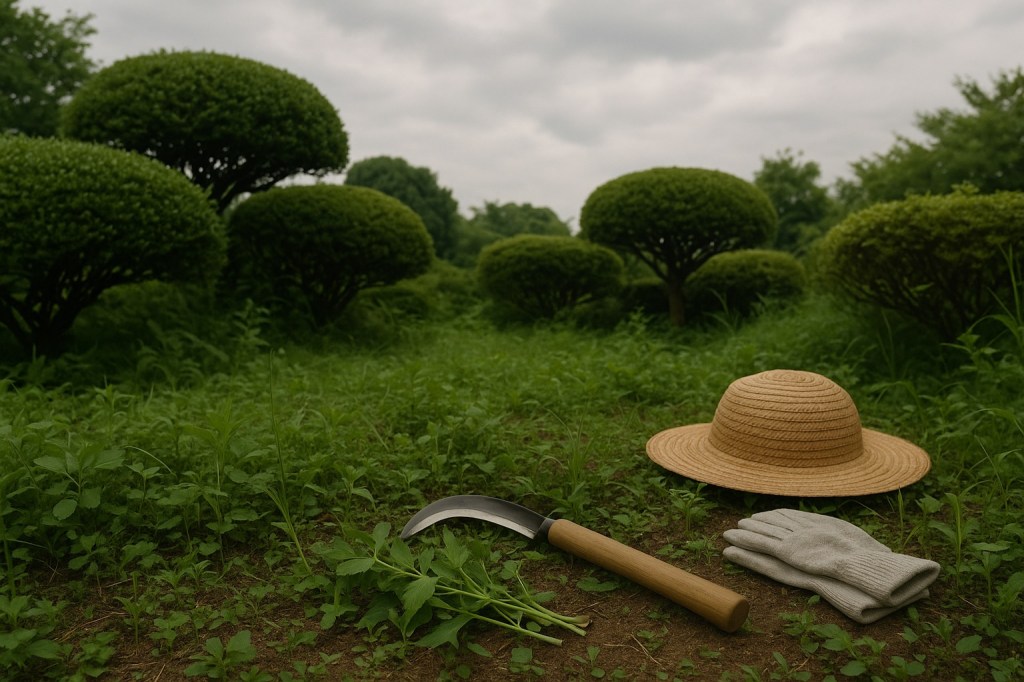
Enter the Kama — a traditional Japanese sickle that’s perfect for this kind of job. Light, razor-sharp, and nimble, it allows me to work in tight spots without disturbing the soil too much. I can glide just under the weed’s base, cut it cleanly, and leave the roots in place to rot down and feed the earth. It’s as much a meditation as it is a method.
The plan is to collect the cuttings and reuse them — either as mulch directly on the soil or added to our compost pile. Nothing goes to waste, and everything returns to the earth.
Nature’s Timing and Mine
The only thing stopping me right now? The rain. Our garden’s been soaked for days. Every time I get ready to go out, the sky opens up again. It’s humid, the earth is mushy, and of course… the mosquitoes are having a party.
Still, I’m not letting that stop me entirely. I’ve got a plan: long sleeves, long trousers, gloves, a good hat, and probably a layer of mosquito repellent just to stay sane. I won’t do everything in one go. But little by little, I’ll shape the garden with the Kama — not against it, but alongside it.
Slow Gardening, Fast Rewards
There’s something deeply satisfying about this approach. Not rushing. Not fighting nature. Just participating in it, one slice at a time.
I’ll keep you updated on how it goes. For now, I’m just glad I found a way to balance my respect for natural growth with my desire to keep the garden livable — both for us and for the life it supports.
Let it grow. Then gently guide it. That’s where I’m at right now.



 Experiences - Life - Inspiration 🇨🇭🇯🇵
Leave a comment