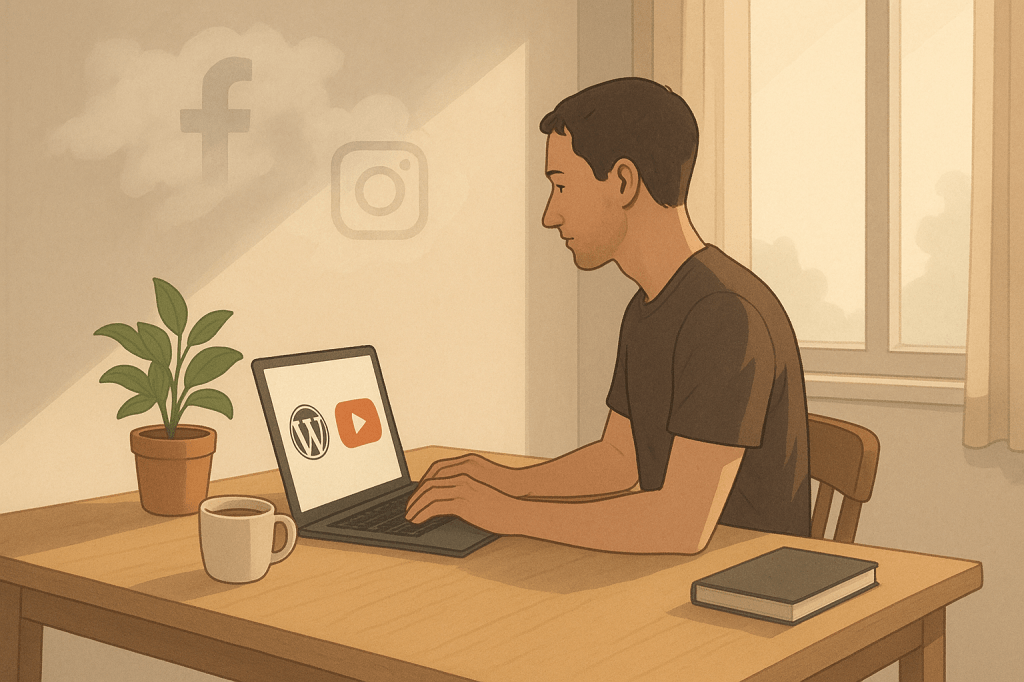
For a long time, I was stretched thin trying to maintain a presence across several social media platforms. I had a Facebook page, an Instagram account, my YouTube channel, and my WordPress blog—all running in parallel. I was creating, posting, checking notifications, comparing metrics, and engaging in an endless loop of digital upkeep.
But here’s the kicker: the more I did, the less I felt I had.
More accounts, less energy.
More posts, fewer results.
More presence, less clarity.
Eventually, I took a step that many would consider radical in today’s hyperconnected world—I shut down my Facebook page and deleted my Instagram account. I didn’t pause them. I didn’t archive them. I closed the doors, turned the key, and walked away.
What happened next surprised me.
I didn’t feel invisible. I didn’t feel left out. I felt free.
The Science Behind My Relief
This wasn’t just a personal feeling—it turns out there’s real science behind why I suddenly had more time, energy, and creative clarity.
1. Cognitive Load and Mental Bandwidth
Every platform you manage consumes mental energy, whether you’re actively posting or simply thinking about what to post next. Psychologists call this “cognitive load”—the total amount of mental effort being used in working memory. When we juggle multiple tasks or responsibilities (like managing 3–4 social media accounts), our brains have to keep track of each one, even in the background.
According to research published in The Journal of Experimental Psychology, the human brain is easily overwhelmed by “task switching,” which diminishes focus, creativity, and long-term memory. Even low-level background thinking about a platform—“Did anyone comment?” or “Should I post today?”—consumes precious mental real estate.
By removing Instagram and Facebook, I unknowingly freed up mental RAM. I wasn’t bouncing between platforms or checking notifications for validation. That alone gave me an unexpected return: presence.
2. Dopamine Fatigue and Reward Systems
Social media thrives on short-term rewards—likes, follows, comments. These platforms are built around variable reward systems, the same mechanisms that drive slot machines. Each post is a pull of the lever: Will it perform well? Will it flop? Will anyone care?
This reward unpredictability is powerful but exhausting. It teaches your brain to crave feedback and constantly seek stimulation. Over time, this leads to what some neuroscientists call dopamine fatigue—a dulling of our internal reward system caused by constant digital stimulation.
When I stepped away, I noticed my attention span rebounding. I felt less jittery. I became less interested in whether something would “perform” and more interested in simply doing good work. Creating became joyful again.
3. The Illusion of Productivity
It’s easy to mistake busyness for progress. Managing multiple social media accounts often feels productive—you’re posting, replying, editing, promoting—but the real question is: What are you actually getting back?
In my case, the return on investment was disappointing. More often than not, the effort outweighed the impact. My audience wasn’t growing meaningfully, and I wasn’t connecting deeply. I was shouting into a void, all while draining my creative energy.
Now, with just YouTube and my WordPress blog, I feel more strategic. My efforts go into platforms I enjoy and that align with my goals. Instead of spraying content across the internet like confetti, I’m placing bricks one at a time, building something lasting.
Focus on What Moves the Needle
Stepping away from unnecessary platforms made one thing crystal clear: focus is everything.
There are only a few activities in life that truly move the needle—the things that actually make a difference in your growth, your relationships, your well-being, and your dreams.
When I was spread across four platforms, I wasn’t focusing on any of them deeply. Now, with only two, I can channel all my energy into work that matters. I can engage with my readers and viewers. I can create more intentional content. I can go deep instead of wide.
This shift in focus echoes the Pareto Principle, or 80/20 rule: roughly 80% of results come from 20% of the effort. Identifying and investing in that crucial 20%—whether it’s YouTube videos, blog writing, your health, or meaningful relationships—is the difference between being busy and being impactful.
If we don’t actively choose what to focus on, the world will choose for us. And it usually chooses distraction.
What I Gained By Doing Less
- More creative energy: With fewer distractions, I spend more time in a state of “flow”—deep, focused work that’s intrinsically rewarding.
- More peace of mind: No more obsessive checking or worrying about algorithms. I’ve reclaimed space in my mind that was quietly occupied.
- More genuine connection: I engage with people more meaningfully through comments on my blog and YouTube channel—platforms that invite depth over dopamine.
- More impact: By focusing only on the platforms that matter to me, I’m creating work that’s more aligned, intentional, and fulfilling.
Final Thoughts
Social media isn’t inherently bad—but it’s not neutral either. It demands time, attention, and energy. If you’re not getting those things back in a meaningful way, maybe it’s worth asking: What would happen if I just stopped?
For me, quitting wasn’t an act of withdrawal. It was an act of reclaiming.
Reclaiming energy. Reclaiming focus. Reclaiming the ability to work on what really matters.
Letting go of what was draining me gave me room to double down on what moves the needle.
And that has made all the difference.




 Experiences - Life - Inspiration 🇨🇭🇯🇵
Leave a comment