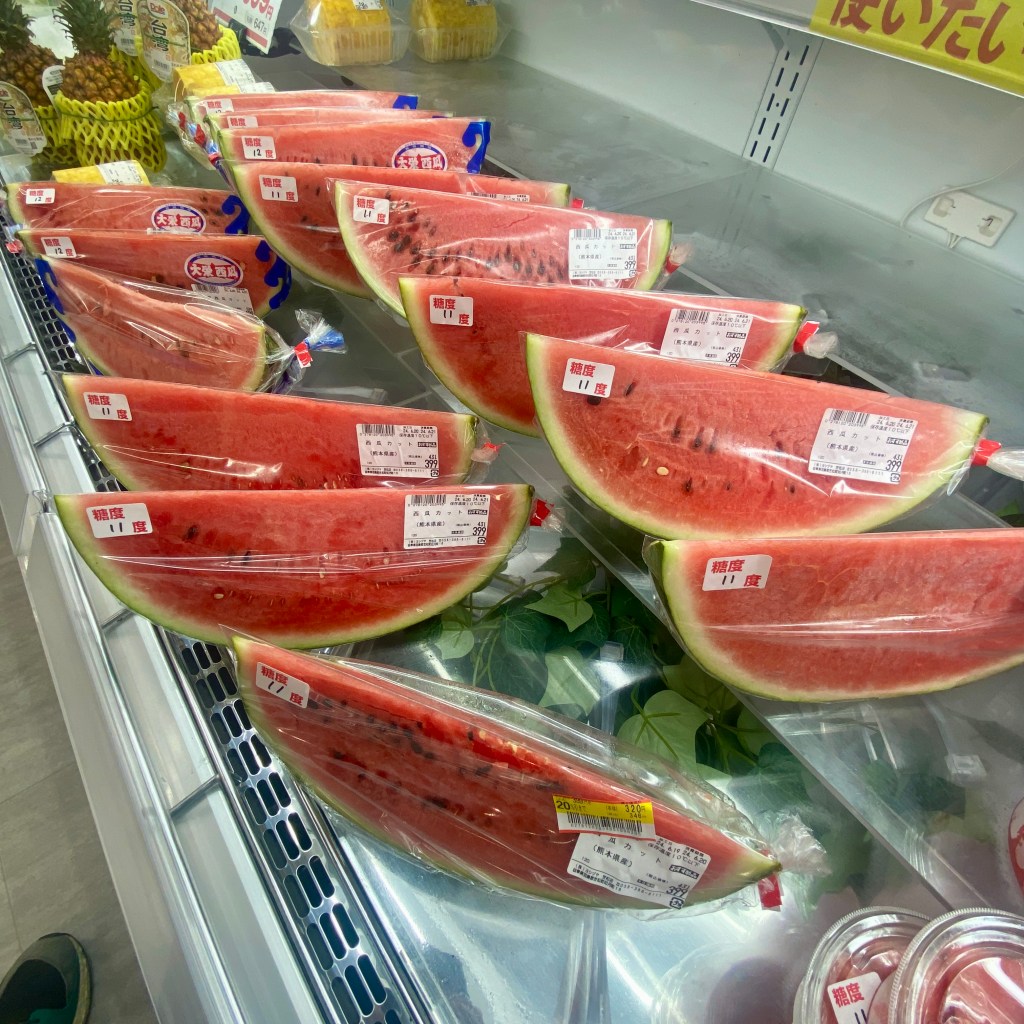
Yesterday evening, while my wife and I were out shopping for groceries, she pointed out watermelons being graded by sweetness at the supermarket. Intrigued by this concept, I delved into the details.
How Does Fruit Grading by Sweetness Work in Japan?
Japanese supermarkets employ a system that measures fruit sweetness using degrees Brix (°Bx), indicating the sugar content in the fruit’s juice. The process involves the following steps:
- Degrees Brix (°Bx) Measurement:
- Definition: It measures sugar concentration in the fruit’s juice.
- Usage: Higher °Bx indicates sweeter fruit, with 1°Bx representing 1% sugar content.
- Grading Process:
- Sampling: Fruits are sampled and their juice extracted for testing.
- Refractometer: A device measures the °Bx using the refraction of light through the fruit juice.
- Categorization: Fruits are grouped based on their °Bx readings, with premium grades having higher values.
- Consumer Impact:
- Labeling: Supermarkets label fruits with their °Bx values, informing consumers about sweetness.
- Premium Pricing: Fruits with higher °Bx values are sold at premium prices.
- Consistency: Ensures consistent quality and reliability.
- Types of Fruits Graded:
- Commonly graded fruits include melons, grapes, apples, strawberries, and citrus fruits.
- Cultural Context:
- Emphasis on food quality and presentation, with sweetness associated with luxury and gift-giving.
- Technological Advancements:
- Some supermarkets use advanced technology like near-infrared spectroscopy to measure fruit quality parameters.
Fruit Grading in Other Countries
Other countries are increasingly adopting similar systems:
- United States: Specialty stores and farmers markets provide sweetness information, and premium brands highlight sweetness indicators in their marketing.
- South Korea: Large supermarkets use Brix measurements for melons and grapes.
- China: High-end retailers emphasize sweetness of premium fruits.
- Europe: Some supermarkets and fruit suppliers offer Brix measurements, especially for premium and exotic fruits.
- Australia and New Zealand: Brix measurements are used for marketing fruits like kiwifruits, grapes, and stone fruits.
- Online Retailers: E-commerce platforms highlight sweetness using Brix measurements.
As consumer demand for high-quality produce continues to grow globally, more supermarkets and retailers are likely to adopt similar grading systems.
#FruitGrading #SweetnessScale #QualityProduce #GlobalTrend








 Experiences - Life - Inspiration 🇨🇭🇯🇵
Leave a comment