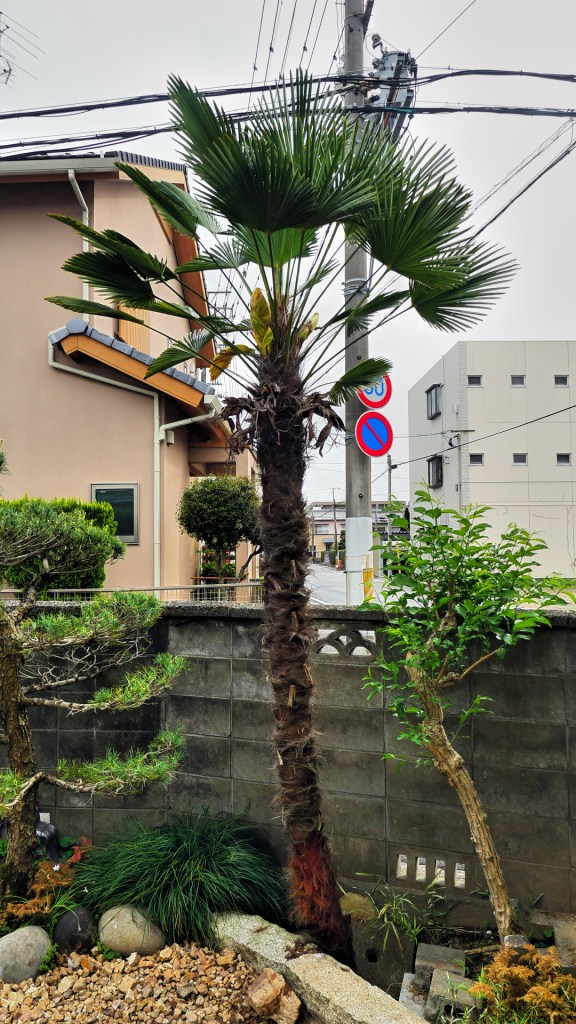
Just a few days ago, I saw our one palm tree growing large, banana-shaped fruits, like corn. Although I was confused at first because I knew they couldn’t be bananas like the ones in Thailand, I was still curious. I only knew that the tree was some kind of palm, but I didn’t know its specific type.
Thanks to the tree’s sudden flowering, I managed to capture a distinct image and used Google Lens, my helpful tool for plant identification. Lo and behold, the mystery palm revealed itself as the Chusan Palm, a species previously unknown to me.
The Chusan Palm, scientifically referred to as Trachycarpus fortunei, originates from central and eastern Asia, notably China and Japan. Renowned for its ornamental allure and adaptability to diverse climates, it has found widespread cultivation across the globe, especially in temperate regions.
Characterized by a sturdy, singular trunk enveloped in coarse, dark brown fibers, the Chusan Palm boasts large, fan-shaped leaves, each deeply divided into multiple segments, reaching lengths of up to 3 feet (1 meter). Depending on environmental conditions, it can attain heights ranging from 20 to 40 feet (6 to 12 meters).
A notable trait of the Chusan Palm lies in its resilience to cold temperatures, capable of withstanding frost and snow—a trait highly esteemed in landscaping endeavors within temperate zones.
While its growth rate may appear modest compared to some palm varieties, the Chusan Palm demonstrates steady progress under favorable conditions, often enduring for several decades or more.
Thriving in well-drained soil and partial to full sunlight, these palms exhibit adaptability to various soil types, though they flourish best in moist, fertile environments. Initial establishment warrants regular watering, transitioning to a more drought-tolerant state once mature.
Commonly utilized in landscaping projects, particularly in gardens, parks, and urban spaces, the Chusan Palm introduces a tropical or exotic ambiance, whether as a focal point or integrated into mixed plantings.
Maintenance requirements for Chusan Palms remain minimal post-establishment, primarily involving the periodic pruning of dead or damaged fronds to uphold aesthetics and vitality. Additionally, seasonal fertilization during spring and summer can stimulate vigorous growth.
As a dioecious species, individual Chusan Palms exhibit distinct male or female reproductive characteristics. While female plants yield small, round fruits containing seeds following pollination, male counterparts contribute pollen for this process.
The seeds, typically dark blue or black upon maturity, reside within the fruits and can be harvested for propagation. However, the slow growth inherent to Chusan Palms demands patience, as germination and maturation may span several years.
Now that I’ve learned these things, I’m starting to learn how to prune properly and how to tell the gender of our Chusan Palm. Watching it every day should help me understand its flowering behavior and figure out its gender.

Gardening #Landscaping #PlantIdentification #ChusanPalm #TrachycarpusFortunei #TropicalPlants #OrnamentalPlants #DioeciousPlants #BotanicalDiscovery #Horticulture #GreenThumb #PlantCare #UrbanGardening #FloweringPlants #NatureLovers #HomeGarden #Observation #PlantPropagation







 Experiences - Life - Inspiration 🇨🇭🇯🇵
Leave a comment