As I found myself puzzled by the identity of the flora in our garden, Google Lens came to my rescue, allowing me to snap pictures and identify the plants with ease. Yet, despite capturing images of every tree, shrub, and flower, the lengthy Latinized scientific names still escape my memory.
Take, for example, the tree captured in the image below. In Latin, it goes by Acer Palmatum, while in English, it’s known as a Japanese maple tree or, in Japanese, a momiji. You might glance at this picture and find it bears little resemblance to the iconic Japanese maple. And indeed, you’d be right to think so. When I first laid eyes on it last year, it resembled more of a tree from a horror movie than a momiji. It was my mother-in-law who insisted it was a momiji, a claim I only believed upon witnessing its crimson maple leaves last fall. Admittedly, I wasn’t fond of its appearance then, but I resisted the urge to remove it. Instead, I embarked on a vigorous pruning regimen during the winter months, hoping to shape it into the picturesque Japanese maple you see in the image today. Despite my efforts, it still retains an eerie aura, but I hold onto hope that it will sprout new branches, allowing me to sculpt it into a more harmonious and aesthetically pleasing form. Although not visible in this picture, the momiji is indeed sprouting numerous new branches and leaves, bolstering my confidence in its potential transformation.

Then, amidst the momiji’s branches, delicate white flowers began to emerge, seemingly overnight, from what I had previously dismissed as long, grass-like weeds. Initially, I ignorantly plucked them out, only to be surprised by their unmistakable scent of leek and onions. Perplexed, I turned to Google Lens, which identified them as Springstar (Ipheion uniflorum), a flower native to South America. My mother-in-law revealed that this flower had graced our garden for years, prompting me to ponder its unexpected presence in our midst.
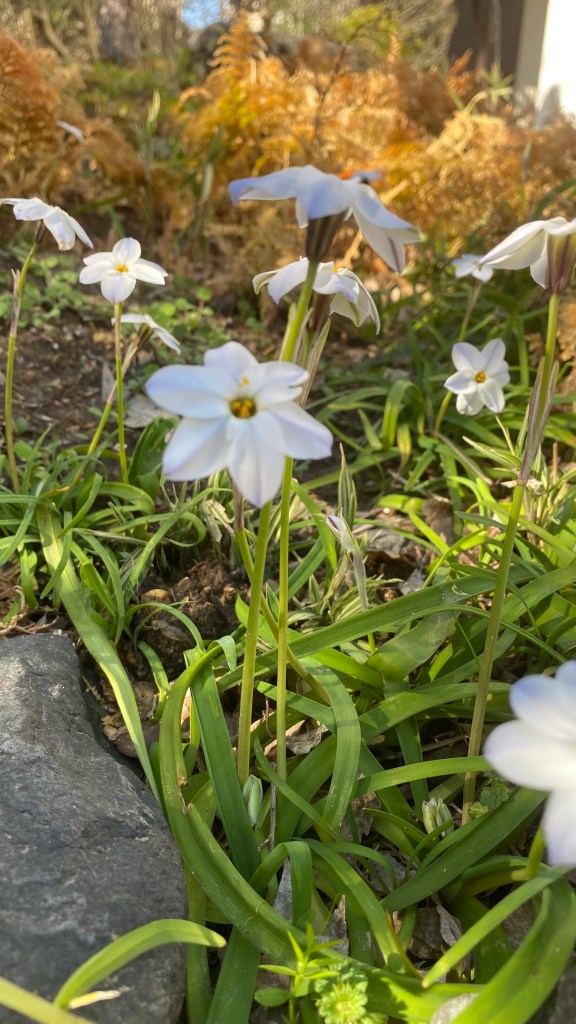
Springstar (Ipheion uniflorum) may not boast soil-enhancing properties like nitrogen-fixing legumes, but it contributes to our garden’s vitality in several ways:
Erosion Control: Much like other ground-covering plants, Springstar aids in soil stabilization, mitigating erosion with its robust root system and foliage.
Soil Structure: As a bulbous plant, Springstar enriches the soil over time through the decomposition of its foliage, enhancing its structure and nutrient content.
Pollinator Support: Its alluring flowers attract bees and other pollinators, fostering biodiversity and indirectly promoting soil health through pollination.
Having gained newfound appreciation for Springstar, I’ve decided to permit its growth where it poses no harm. Its blossoms, I must admit, possess a certain charm now that I’ve witnessed them in full bloom.
While I was busy layering our raised garden beds like a lasagna, meticulously removing stones and pebbles, I unearthed countless bulbs whose identities remained a mystery. Opting to plant them in the side pockets of the raised beds, I eagerly awaited their transformation. Just recently, they burst into bloom, revealing themselves as snowbells Spring Snowflakes (Leucojum vernum) akin to the Japanese snowbell (Styrax japonicus).

Although I could continue recounting the surprises our garden has yielded, I’ll save them for another blog post.
Wishing you a splendid day!





 Experiences - Life - Inspiration 🇨🇭🇯🇵
Leave a comment